What Wants to Grow

When planting a garden, it is always nice to consider what wants to live in your area, rather than simply what you want to grow.  Consider being flexible in your chosen flavors, and expand to include unfamiliar tastes that happen to need very little care in Hawaii.  Here in Hawaii with the multitude of micro climates, one often feels fortunate when they discover something that becomes almost “wild” in their garden.  Other gardeners actually mope and complain, while ripping those plants out.

Such culinary wonders as mint and Florence (bulb) fennel spring to mind.  I know many who can grow these plant, but they do not.  They claim that they do not like the taste of them.  The point that I often make is simple: learn to like what likes to grow where you are.  It makes life oh so much easier, and it brings you into new culinary adventures as well.  Letting some of your beans and greens go to seed, and reseed themselves is a great joy, if you let it be.  Let your garden be a little less controlled, a little more lush, and give up on trying to dictate what grows where, and when.  Be an observer, and celebrate how nature leads the way with gardening lessons just as important as those that we search out in workshops and books.

If you notice that your Giant Red Mustard seems to shine in your garden, leg it over to your nearest library and seek out recipes that call for mustard greens.  Mint is expensive in the shops, but loves to tuck in under a drippy eve, or hose.  Mint pestos, mint coolers, mint dappled in fresh salads, or asian style noodle soups.  Research and celebrate, and I promise your gardening days will shine a little bit brighter..

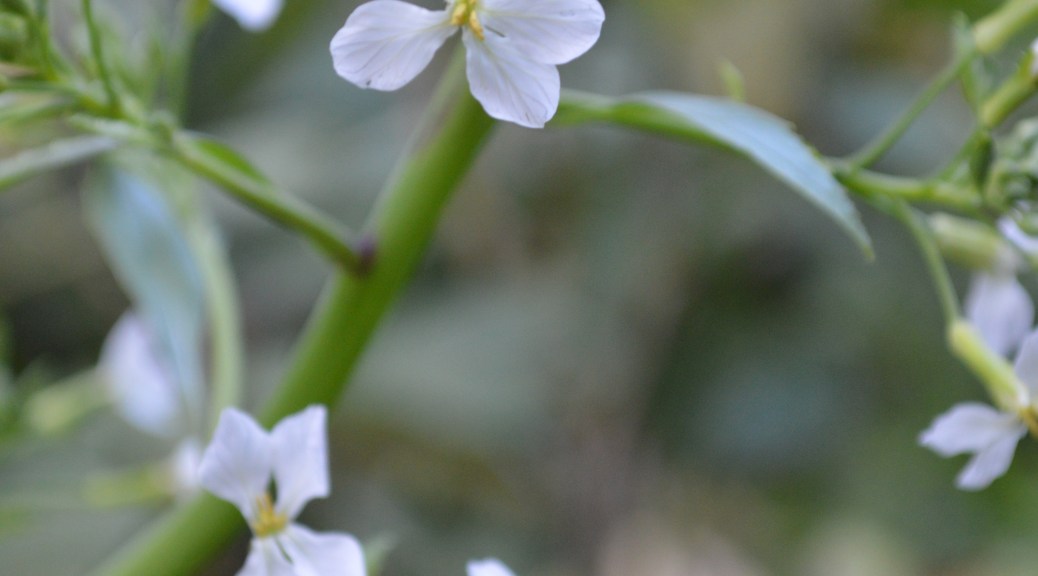
Mint becomes a lovely ground cover underneath edible radish blooms.  This no till garden has many layers of life, just like nature itself.  Radish blooms will soon give way to radish seed pods that can also be harvested young and chopped into your dishes to make a meal sparkle.

Gardening Gratitude

I offered seeds in an innocent gesture prior to a class on positive communication. The woman who rejected the seeds assured me that neither the woman that I had inquired for, nor she personally had “time to garden.” It was growled at me. I kept the beautiful seeds tucked into my jeans pocket and wondered where have we gone wrong?

seeds

Gardening is considered a hobby in much of the United States.  We all know that we are conditioned by cheap low end food that is low in nutrition and light on the budget thanks to government subsidies and mass importation.  You are often hard pressed to locate local produce at grocery stores in Hawaii. People here in Hawaii often pick fights with me noting that they cannot afford organic vegetables, nor can they afford to take time to even grow one potted plant, then they drive away in $50,000 cars or trucks.  I’ve begun to wonder if they are happiest being unhappy.

These fights go nowhere, as they are one sided. I often simply reference their ability to make more of their dinners from whole food, rather than buying so many “ready made” meals that cost a fortune.  But part of me questions what is below the surface of these confrontations over things as simple and pure as whole food and free seeds?  I’ve gotten hate mail, harassment, stolen crops, and worst of all intentional crop destruction. I just want to provide food without using chemicals.

I once had a large group out to the farm for an educational tour.  They were seed savers.  It surprised, and disappointed me that three would mention stealing seeds from the farm, worse yet, laugh about stealing when I asked them not to.  Why would they pose as ethical, sustainable farmers and then steal?  What is the world coming to? I had already taken the initiative to share my knowledge and to hand pollinate, harvest and dry seeds for this group. They knew I would give my seed work to them in the form of seeds that would make squash growing easy.  It took years to accomplish this, but the point was to get Hawaii replenished with these vines that once covered the islands. I also had to wonder, how many more did, and didn’t tell me?  It made me wonder about gratitude and greed.

Many flock to Hawaii and expect all to be as perfect as the weather. The problem that confuses many here, is even when “paradise” or kindness and generosity is served up in the form of open sharing of knowledge, free seeds, or beautiful food, it is still rejected, stolen, or mowed down.

Recently, my neighbor died of an overdose.  Though shocking, it changed my life wildly. You see, my neighbor stole from my garden nearly every day.  She stomped plants, and then complained that she would take even more if she could identify what “weird” things I was growing. She complained about the taste of the beans.  I couldn’t comment, because I never got any. This was the second time in Hawaii that I had a neighbor like this.  I’d like to say that I was ready for this, but you never really are.

I work hard to defend myself from the verbal attacks and online trolls, there is little to do to protect your plants in your absence.  No fence, nor confrontation could keep her out.  What confused me initially was the stealing.  I offered a bounty to neighbors every chance I got, in part just due to kindness, but also hoping to keep thieving neighbors to stop crushing the plants. The more I offered, the more that was stolen.

Soon after, the man down the street started stealing more from my garden. He was stoned every time I encountered him. One afternoon, I went over to visit him, and asked him why my vegetables were on his lanai.  Rare heirloom vegetables are easy to identify.  Another time I went to my dance class where a woman boasted about stealing my pipinola (chayote) through the fence. I told her that she was stealing the fresh food from the pet pig.  Her jaw dropped.  She never considered a charging 400 pound pig into the theft equation, Perhaps it was the shock that she was looking for, she smiled and bragged;  she wanted to make me react. I realize Hawaii has problems with untreated mental illness, as well as overwhelming drug and alcohol addiction, but it now seems like it is hitting record levels. If you don’t believe me, plant something in your garden and set up a camera, and see what happens.

Two of the chefs that I supplied, and one of the grocery stores, all admitted that they have bought avocados, mangoes, citrus, squash, and other crops from “unknown sellers” who were not known as food producers.  One of the chef’s was thrilled to be getting “free produce” from a man who only wanted to receive meals at the restaurant.  What was happening, was “tree clearing” or field clearing thieves who roll in after dark were stealing through their “gathering” and then delivering and selling of produce that wasn’t theirs.   The farm has had tracks in the lime field from unknown vehicles driven between the citrus trees that were now empty. My squash curing table was raided many times, my seed pumpkins were stolen off the front step.  Tomatoes off the vine.  None of these people were hungry.  Drugs were the most common thread.  Agriculture crime is now being prosecuted in Hawaii, and it is indeed a growing trend.  These family farmers don’t get a break: 90% of the food is imported, the 10% that is locally grown, is then vulnerable to thieves and vandals.

Gratitude is a hard one to teach.  Many learn empathy, and gratitude when they are young, as they do it naturally, they just don’t have a name for it.  Others due to their design, will never develop gratitude.  They can mimic it, but they mimic it so to use it as a tool to manipulate.  That’s not gratitude,  Hopefully, we learn to take care of our things, and to not always want more.  Greed kills gratitude. When looking at the culture surrounding us, one hears the opposite message:  that “more” will fill the void, and empower us.  It’s really just a distraction and often a parade of power, or overpowering another.  For those of you who read my earlier post about my delivering bananas to my neighbors, I did make an effort, and found out who my kind neighbors were.  On the other side of the coin, through watching my garden, I learned also who the thieves and vandals were too.

Can we teach grownups to be grateful, even if they were raised in homes where it wasn’t taught, or where they had to be greedy in order to survive?  Can we teach the lady at the office to open her hand and her heart and accept a gift of seeds? and if she can use them, to share them with a neighbor who would like a chance to share in the beauty and potential captured within a seed and a garden. Can we as individuals continue to give, even when the receiver is ungrateful, or even unkind? We must.  We simply must be better.

These are tough situations to face, but many gardeners already understand the gratitude that can come from their labors.  Watching a garden grow is humbling, and sharing the bounty is rewarding. People can steal, stomp or mow down your fields, but they cannot steal your knowledge or your stamina,  It’s heart wrenching to deal with these people who struggle with, or are devoid of personal ethics and compassion for others.  But gardeners are resilient, and their knowledge is like an iceberg:  85% is unseen, and unable to be stolen. As difficult as it is, what better place to face these tough social issues then in the garden where life, potential, and beauty surrounds.

Lessons in the Bananas

I decided to share this, though I am not proud of what I have done.  I got a speeding ticket that I deserved. Here is part of the essay that I wrote, perhaps in sharing, we all can learn from my mistakes.

I was the third car out of five in a pack that was cruising along. The two ahead of me were ahead of me because they passed me. Lots of cars passed me, at least 15 since Hilo. I started counting cars that overtake me as a habit when I drive my own little old car. Because it is so old and small, people will do anything to overtake it. I have been driving for 28 years, and I had a perfectly clean abstract until that day on the new Saddle Road. I have driven commercial vehicles, cargo vans in NYC, summer school kids in school busses, and every other situation you can imagine. But that day, I didn’t hit the brake fast enough, and I was cruising in the pack rather than slowing down considerably. Lesson learned. But it is also that clean abstract that makes me want answers. Answers I didn’t receive.

I was aware enough of the situation around me. I was braking, but obviously not hard enough. I had put my flashers on because a police car had pulled over the lead car in the hidden corner of the bend. My headlights were on for visibility, and I checked all my mirrors and found another police car approaching at high speed with emergency lights but no siren on. It was in the most dangerous area as we approach the military intersection, where there are yellow lines all around. I pulled over, to let him pass, and the police car tore by so to pull over the car ahead of me. I signaled, checked my blind spot, waited for the other two cars to pass, and began to pull out. The officer waved an angry arm out the window that I should stay put too. So that made 3 out of 5 cars pulled over. The officer walked back to the car and yelled at me before he even reached the vehicle. He was yelling that I was doing 67 mph and the car ahead of me, that passed me, was only doing 60 mph. He was mad, and I knew more than to disagree with him. I have been an educator long enough to recognize bullying techniques. Accuse someone of something extreme and make a fight, then switch mode and say that you were defending yourself. That is also a stress reaction when you are burned out.

I zipped it, though I wanted to tell him my side. To enter into an argument with someone that was already irate, was not a good idea. He continued to yell at me about how I was going 67 and the other car was going much slower. I remember thinking that if that were the case, I would be bullying that car off the road. I would have been on it’s bumper in no time. And equally important, If that was the case, that officer was probably doing 15mph faster than me in order to overtake me, making him travelling at 82mph, which would be quite dangerous in a 40 mph zone, and also it would have called out for a much greater braking distance than what actually occurred. It was pretty clear that I shouldn’t make note of my own calculations, or he may likely pull my license even though it was a first offence.

I think it should have been clear that I was not much of a fighter, and certainly no threat to the officer. I was quietly sobbing while he yelled. I was scared because it was like what you see on the news. He eventually gave up on me, maybe because I didn’t offer him the fight that he seemed to want. When I saw him approaching the car again, even though I had ticket already in hand, and all I could think was “God, now what?” It was clear that I was shaken, and upset and in no condition to drive at that moment, so I read my ticket as I regained composure. So what does he do? Command me to go, to drive, to basically clear out of there so he can have the space so that he can pull over multiple cars all afternoon. I just shook my head at him in my best “really? Give me a minute” look and eventually drove away. I had a lot of questions that would remain unanswered. If he was as concerned about road safety as he noted, why didn’t he use his siren? Why did he pull over multiple cars at once? Why didn’t he explain the shifting speed limit. Why would he command me to drive when I was clearly too upset to do so safely? Why would he accuse me of going faster than the car ahead of me?

As I drove back to work, I thought a lot about him, and I was mad as can be at him and his attitude. I counted cars again, with another 12 passing me, and one “rode my bumper” to the end of the highway so close that I could see the color of his eyes in my mirror. All I could think was, “is this working?” Is it inspiring road safety? What was my take away? Did I learn a good lesson? In some ways yes, I understand that I was speeding. But what was taken away was just as great: I lost faith in our local police. As I drove, all I could think of was how happy I was not to be like him. But as the days passed, and I reflected upon it, I thought that he too probably didn’t want to be like me. I was just as stressed out as he, trying to do too much and speeding so to try to cram more work into my life.

I decided to administer my own “sentence” if you will. I forced myself to take a day off, to rest, and to do good. As a farmer, there are no days off until you get injured. So this was really hard for me to do. What I did as punishment for my being a “stressed out speeder” was to take a 100 lb rack of bananas that I grew, and divide them up so that the whole neighborhood got a share. It may have made more sense to sell them to a restaurant and that would have paid the ticket, and just “be done with it,“ but that would not have offered what I ended up taking away that day. The real lesson was to go door to door and listen to my neighbors, because that was what I was really angry about. The police officer didn’t allow me a safe place to state my side, to educate me, or allow me to feel safe in questioning his judgment. I figured that other people needed to be listened to as well. So I spent a day giving my neighborhood that opportunity.

OLYMPUS DIGITAL CAMERA OLYMPUS DIGITAL CAMERA

What I learned was pretty humbling. I may have been mad at myself for speeding, and at the policeman for yelling at me, but my neighbors, who I was a stranger to, shared stories of long stored grief and pain. I talked to the elderly that were home in the middle of the day. We talked about the fears they have about aging, about kidney transplants, the haunting memories of the Korean War, and of loosing their husbands and wives through death. My entire neighborhood was hurting, and I had no idea. I was doing the same as so many others, just work yourself silly and zoom between tasks, and cram your life so full of obligations, that you forget the real lessons of life: to mourn, to forgive, to heal, and to listen. Be a good neighbor and think of others.

In summary, that is what a speeding ticket is about. We are putting ourselves above others at the risk of public safety. We think our lives are more important, or our obligations more necessary, so we push the speed up so to “live more” when really we may be missing life around us in more ways than one. Did I learn a lesson? Yes. Will I do my best not to do it again? Yes. Do I deserve to be punished? Yes.   But the biggest reward for me was learning that my own heart could be transformed, and to come to the realization that the policeman, who I was previously so mad at, probably needs someone to stop by his door with a bunch of bananas, and to be there to listen, just as badly as my neighbors did.

the pursuit of pumpkin