Save money by changing out your own delivery vehicle tires

After getting the bait and switch treatment at our local tire shop, I decided to get even in two ways:  teach everyone how to do much of their tire replacement themselves, and not give that shady tire shop even the smallest job ever again.  After getting an outrageous quote of $1500 to replace 4 VW tires with very cheap but normal tires, I decided to to all but the tire mount/balancing myself.  I was hoping they might at least order the tires for me at a good price, but nope they overcharged from the start.

They even double billed for the labor performed for the one (I tested their ethics with one tire) tire to be mounted and balanced.  Machines do the mounting and balancing in all tire shops, labor means lifting tire onto machine and off of machine. It takes only a couple of minutes, the machines do everything.  So imagine my surprise when they added $20 in extra labor charges on top of the $20 quote.  I called them on it, and they claimed that that is their policy.

My policy is to never help their business ever again.  Be grateful for the customers you have, or they will teach the world how to change out all of their own tires.  In the first video, forgive me for having sloppy camera work, the other video I made was much better, but too large for the upload.  I had a few minutes to get this post out, so bear with me.

Why am I teaching you how to change tires on a farm website?  Because these cars are my delivery vehicles, and by doing it myself, The job will cost me under $300 tires included.  Every small farm needs an edge, this is one that you may thank me for later.  Get comfortable with your car, understand the workings, use safety equipment, and off you go.

Chili Pepper Pruning and Rooting Cuttings pt 2

Updating on my first attempts at pruning two year old Ghost Peppers, Aji Limon, and Thai Dragon chilis as well as rooting the cuttings. It has been a week, let’s see where we are at

DSC_0398

Here are two short videos that document what I have learned about chili propagation in the past week

Key Points:  “Y” shaped pepper plants do not produce as well as those who have undergone severe pruning in year one and two

regrowth happens pretty quickly if timed to coincide with Spring growth cycles

Be brave! It is proven to work.  Watch my attempts and other videos from chili experts before pruning

Spoil them rotten with care both before and after pruning

Give them fish emulsion fertilizer before and after to encourage powerful plants

document your attempts, as in before and after shots, so that when you are neck deep in chilis, you can laugh about your fear of pruning.

Small Steps to Save Water on the Farm

Drought comes and goes, so what better way to get your farm or garden ready, then by taking some small steps now.  You will already have a water saving style in play if and when you have a dry season, year, or series of years.  Being a zero-waste farm is a great way to think of ways to give things a second chance, be it containers, or water, the main reuse featured here. Thinking in terms of water reuse will become natural when you think of water every time you turn on the hose.

Here is a quick and efficient way to make fruit fly traps.  For those of you in areas like Hawaii, fruit fly trap making is a critical part of most farms.  It is a great way to reuse plastic cups and bottles as well as reuse soapy water from the drain of the hand wash sink.  I use Dr Bronner’s Pure Castile Bar Soaps at the farm and at home.  Each bar goes a long way and there is a scent for everyone.  Peppermint is a really great one for scrubbing up after stinky jobs like composting fish.  The pure soap make for a great soap water base that is used in the bottom of your fruit fly trap.

DSC_0365

Simply catch the soap water as it comes out of the modified drain pipe, then pour into your homemade fly traps, and insert the appropriate fly bait.  Soapy water is used to keep the flies from climbing back out of the trap. The middle and last images are house/bottle fly traps used to control fly numbers near the compost/fish emulsion station.  All are made using items that were free and needed a new use.

DSC_0369 DSC_0367 Jumbo fly trap near compost

Hot dry weather means flies of all kinds are in peak numbers at the farm. The flies drown quickly in the soapy water, and are then composted. Your fly numbers will be kept in check.

Rinse water is used to rinse many buckets in a “bucket to bucket” reuse before it is reused to make a diluted fertilizer as in my video above, or water seedlings and for rooting cuttings. Plain non-soapy rinse water can also be poured into shallow trays for the birds, bees, toads, and lizards that patrol the farm and help in so many ways.

I challenge you to fill a few buckets as if you are in preparation for the water to be turned off, then see in one day how many ways you can use those few gallons.  You may be surprised how far it will go.  We will all thank you for it.

Rare Gori Blue Mottled Pumpkin Trials

Growing Species Maxima squash in Hawaii has its share of complications, which is why I do not give up.  I am looking for solutions.  In the islands, Maxima pumpkins are rare, usually only showing themselves in giant pumpkin contests. also, they are usually not grown organically, even though chemicals are of little help when it comes to the two big island foes of the squash family: Pickle worm and Melon Fly.  Throw in three other varieties of tropical fruit fly, endless powdery mildew, and seed digging, fruit munching rodents, and cheap low-end hybrid squash arriving on our shores in hundreds of tons, there is a reason or two why the state of Hawaii lost this crop commercially.

…but it is tasty…and beautiful, so I continue on with my quest

DSC_0339

(Sorry to the kind people of Georgia.  I’ve used the outdated name “Republic of Georgia” in the video, and also noted that it was in Asia rather than Europe.  I should have consulted the atlas first!)

That is a little background so that you understand why a success with a pumpkin is a success in a much larger sense.  Take the Gori Blue Mottled pumpkin of Gori, Georgia (Europe.)  The seeds have been in my possession after Joe Simcox the Seed Explorer wanted to see if I could grow them out for more seed.  I cringed at the thought of struggling with yet another nearly sure to fail Maxima, but I agreed, and I am happy that I did.  You see, as it happened, I learned a lot from this pumpkin. It dodged a very critical bullet in that it managed to avoid detection of the oh so sneaky Melon Fly.  It did not avoid the gaze and destruction of the Pickle Worm

/moth.  But one out of two isn’t so bad, it is somewhat manageable as long as you know what you are getting yourself into.  Both predators come in cycles, related to seasons, heat, moisture…the usual.  If you give your plants enough nutrition, these long season growers are sure to have a few fruits that manage to avoid the moth/worm cycle. Pickle worm attacks stem, bloom, pollinated fruit, un pollinated fruit….yes, everything. They were the last straw for our commercial pumpkin industry. The ornamental Maximas are much easier to grow

DSC_0337DSC_0335

(think Halloween) the bland, non sweet fruits tempt no one, human nor Melon fly.  It does make a great treat for livestock and pets who don’t care that it is tasteless and watery.

So featured here in the video is a roughed up 2nd generation specimen that fell out of a tall shrub.  The robust vine got a bit carried away and climbed high, only to have the 15 lb fruit crash down during a windstorm.  In the quick video, I make a few mistakes, one being that I say it is small for it’s size, I meant to say it has a small seed cavity for it’s size, a great point for culinary varieties. I infer that it is small…but only small for me (15 vs 30 pounders)  I also note that I am going to plant them in the kitchen…oh well, I would re-shoot, but it is already prepped and a good quantity was eaten by me.  So bear with me. I also would like to recommend Hawaii growers to break off the thick stem of all Maxima variety, due to a multitude of reasons that I  will cover later.  Just trust me on that one, and I hope all will be inspired by a little “squash success.”  DSC_0338

Learning to Propagate Chilis from Cuttings

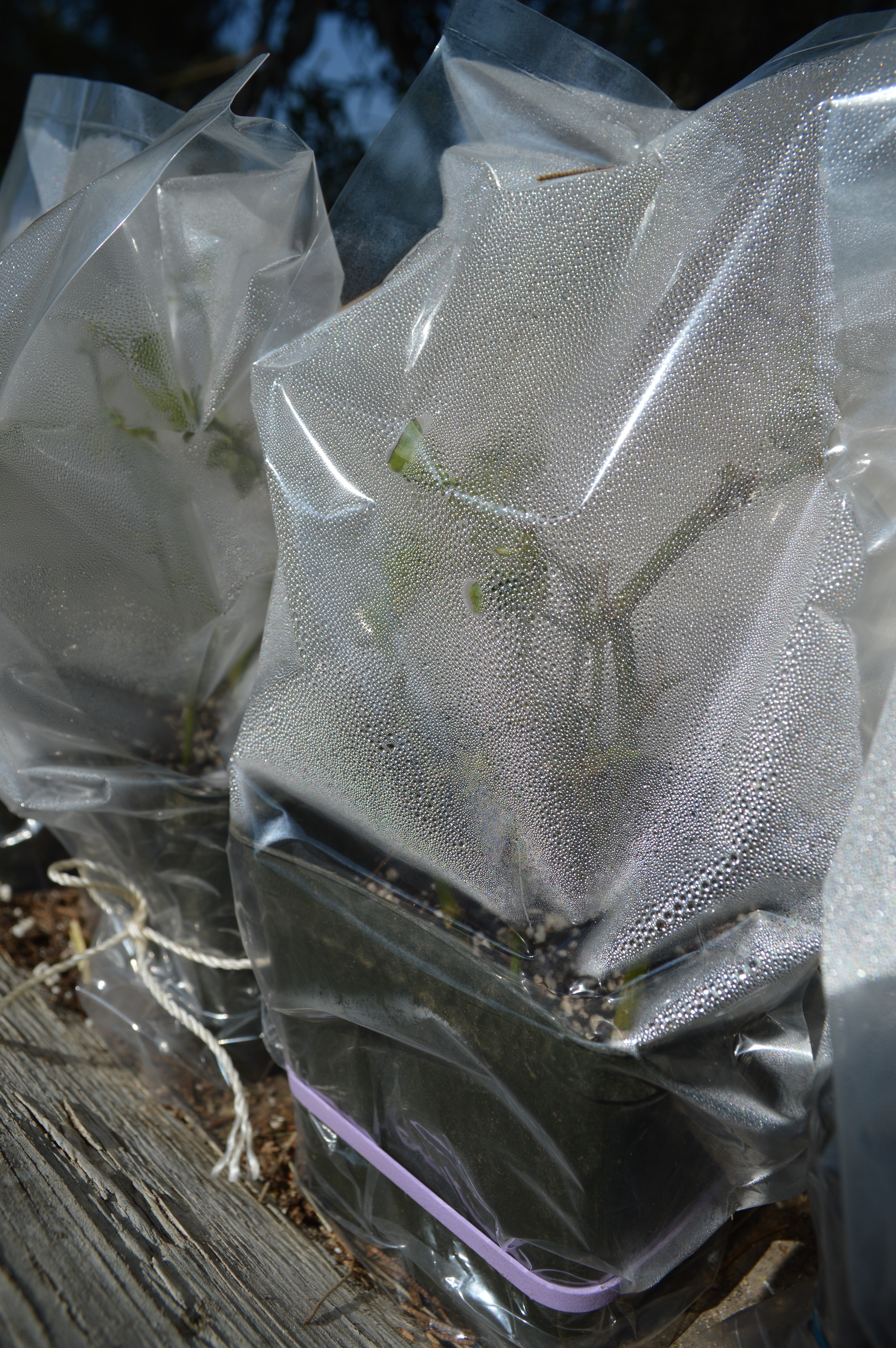
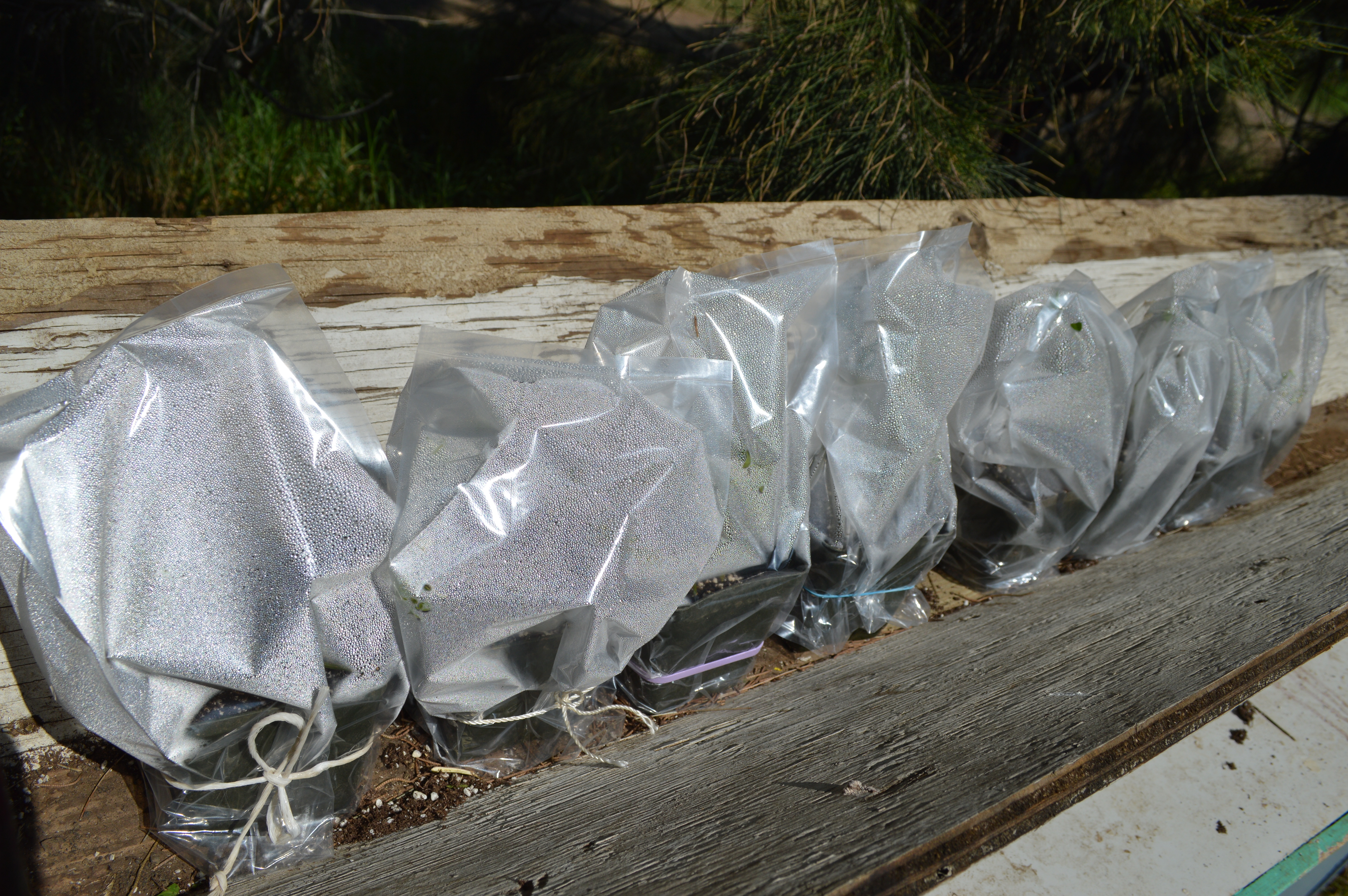
It was time to give the yearling Ghost Pepper plants a severe pruning.  Reducing them by 50% was less painful, when I got the idea to propagate from cuttings.  Here  are my attempt to do so using the simplest of tools.  Reclaimed growers rockwool are used for some, while potting mix is being used in others.  Other tools needed are : large sandwich type plastic bags, rubber bands, or string, small containers, trays of water, a sharp knife, pruners, and liquid (or powdered) rooting compound.

DSC_0326 DSC_0325

I used cutting from my Ghost pepper plants, Aji Limon, and Thai Dragon.

hot housesmini hot houses

Tips:

Keep them moist and out of direct sun (these were moved after being photographed)

Short stems with two sets of leaves are best

Avoid using woody stems

Slice stem at an angle to increase rooting surface

Remove all leaves except for growing one at tip

Use bags to keep humidity high

label varieties

roots should form in 3 weeks

Transplant into soil after 3 weeks

No-till Seasonal Rotation

It was challenging to time my rotation this Spring.  I had waited and waited and tried to coax out every pumpkin I could get.  Then when the production made a swift drop, I went with a hunch and climbed up on the tractor to mow the vines and the grass. There is a point, that even after pruning, and amending the squash plants, where their production levels take a severe drop.  For me this came just short of year #2 when the well tended vines were about 21 months old.  I watched daily for male blooms, but when even their numbers were down, I made the drastic cuts and rebuilding that I will be rewarded for later this Summer.

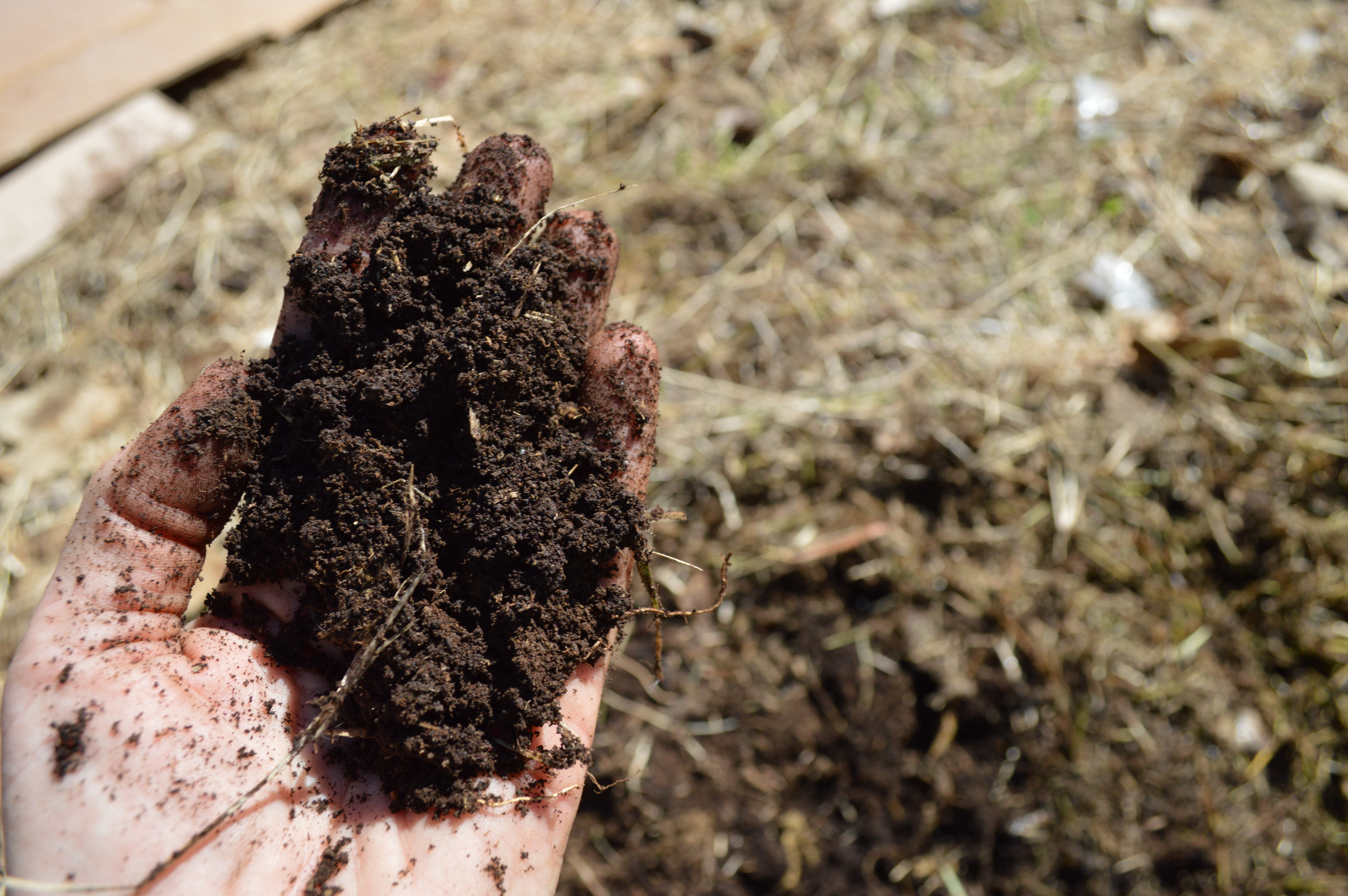
The no-till patch is created in a clock like pattern of raised mounds of homemade soil.  The mounds were constructed from brewery waste hops, horse manure, mulch, coconut fiber, and fish emulsion created in April of 2013.  The images show the following: The mowed field grass dried in the sun, checking the farm made soil mounds for quality, new cardboard was sheet mulched into the center of the “clock like” growing patch. This card board builds soil, retains water, and will give the worms a great place to thrive.  I started to wet the cardboard with the overhead, then the rains came, which was very good luck. Next image is of roughly 1/2 of the clock patch being mowed and altered to a time.  I have weekly orders to fill, so I must leave as many active plants going as possible, while I begin the new plants.  Weather can be very up and down this time of year (hot days quickly turn to cold horizontal rains like today) Growth can be sluggish for the vines that like normal summer type days.  Next image, I am pulling back the cut grass to show the growing mounds that became lost in a sea of vines and creeping grass.  These mounds will be weeded, amended with farm made fish emulsion, then surrounded by cardboard as in the circle center.  Then I will replant with a variety of heirloom squash, some tomatillos and okra…maybe some eggplants…

It felt risky to chop any vine that was producing, but I know as those new productive vines sprawl in a couple of months, I will be sitting back in my chair, sipping a lime aid, thinking that this was exactly what needed to be done.

 DSC_0108 DSC_0107 DSC_0106 DSC_0103 DSC_0102 DSC_0098

the pursuit of pumpkin