Tag Archives: Zero waste

Small Steps to Save Water on the Farm

Drought comes and goes, so what better way to get your farm or garden ready, then by taking some small steps now.  You will already have a water saving style in play if and when you have a dry season, year, or series of years.  Being a zero-waste farm is a great way to think of ways to give things a second chance, be it containers, or water, the main reuse featured here. Thinking in terms of water reuse will become natural when you think of water every time you turn on the hose.

Here is a quick and efficient way to make fruit fly traps.  For those of you in areas like Hawaii, fruit fly trap making is a critical part of most farms.  It is a great way to reuse plastic cups and bottles as well as reuse soapy water from the drain of the hand wash sink.  I use Dr Bronner’s Pure Castile Bar Soaps at the farm and at home.  Each bar goes a long way and there is a scent for everyone.  Peppermint is a really great one for scrubbing up after stinky jobs like composting fish.  The pure soap make for a great soap water base that is used in the bottom of your fruit fly trap.

DSC_0365

Simply catch the soap water as it comes out of the modified drain pipe, then pour into your homemade fly traps, and insert the appropriate fly bait.  Soapy water is used to keep the flies from climbing back out of the trap. The middle and last images are house/bottle fly traps used to control fly numbers near the compost/fish emulsion station.  All are made using items that were free and needed a new use.

DSC_0369 DSC_0367 Jumbo fly trap near compost

Hot dry weather means flies of all kinds are in peak numbers at the farm. The flies drown quickly in the soapy water, and are then composted. Your fly numbers will be kept in check.

Rinse water is used to rinse many buckets in a “bucket to bucket” reuse before it is reused to make a diluted fertilizer as in my video above, or water seedlings and for rooting cuttings. Plain non-soapy rinse water can also be poured into shallow trays for the birds, bees, toads, and lizards that patrol the farm and help in so many ways.

I challenge you to fill a few buckets as if you are in preparation for the water to be turned off, then see in one day how many ways you can use those few gallons.  You may be surprised how far it will go.  We will all thank you for it.

Building Worm Paradise in Hawaii

Being raised on a Wisconsin farm may have given me rather high expectations for soil. Our humble 40 acre farm had deep, rich, black soil that you could sink your arm into, well past your elbow. That was considered “below average soil,” and that is where my false soil illusions began.

My brother and I would hunt night crawlers and all kinds of earthworms for Summer trout fishing. It was rarely much of a challenge to fill a bucket in a few minutes. The biggest challenge was to dig without severing the multitudes of them that squirmed below our shovels. We often abandoned the tools so to dig with our hands. We also wanted our worms to be happy and content in their last hours before they became trout bait. So sever we would not.

Fast forward over three decades and several thousand miles and land me in the Hawaiian islands where you would again find me digging in the dirt in search for worms. The result was quite different, because day after day, I found none. Not a single worm. This was a discouraging discovery that I needed to resolve, because if there were no worms, there would be no farm.

Industrial agriculture, wind erosion, lack of cover crops, multi year drought, years of nutrient depleting sun, and lack of organic materials, are things to consider when beginning a transition plan for a parcel. Though this area was prized for being some of the richest soil in Hawaii, that estimate took into account only soil type, and left nothing to be said for soil treatment.

The summary was easy: there was nothing to temp a worm to take up residence, and every other action on the farm was contingent upon this cornerstone of soil health.

The solution was equally clear: create a worm paradise.

If key players like worms were missing, that was a good indicator that other members of the soil building chain, like soil microbes, were also in short supply. I decided to focus my attention on the actions of one person, and develop a farm plan based around a worm’s favorite location: the compost heap. Creating a farm that was comprised of an organized pattern of composting heaps that would be piled on top of existing soil. The squash crop to be would be planted directly into the decomposing heaps, benefitting by the heavy food source available. The worms would be able to pull nutrients from this moisture and food rich pile, and bring the nutrients deep into the depleted soil.

No-till was an easy choice for methods, because a decade long drought and wind erosion had left little to till. No-till gardening techniques were expanded to a 1/4 acre scale. Between garden and farm in proportion and methodology, this framework would conserve moisture, encourage microbes, worms, and stifle weeds.

three sisters method of beans, corn, and squash, surrounded by reclaimed cardboard.  Soil building and moisture holding cardboard also minimizes weeds
three sisters method of beans, corn, and squash, surrounded by reclaimed cardboard. Soil building and moisture holding cardboard also minimizes weeds

Cardboard created a zero waste solution, along with growing blocks reclaimed from the local hydroponics farm. Together, the cardboard, and both basalt and coconut coir growing blocks would create a moisture holding, shady mulch where worms could hide and soil would form. As pumpkins were harvested, some would be chopped into chunks and buried face down in the mulch. This created “worm buffets” that were also cool hiding places where worms could gorge and reproduce.

The image says it all.  The additions have changed the soil dramatically.
The image says it all. The additions have changed the soil dramatically.

Now a year later, the soil is several inches deep of sweet smelling soil. Just like the days of my childhood, I often dig with my hands so not to risk severing any of the welcome guests that will not become trout bait. An “intensive soil care” initiative was the first move for the farm, and the efforts have surprised even the most hardened of soil scientists. Now reconditioned into a healthy soil system, EM-1, homemade fish emulsion, and coffee grounds are the additions made to the area.
OLYMPUS DIGITAL CAMERA

OLYMPUS DIGITAL CAMERA

Vines now tumble and interlock with each other, birds, bees, and butterflies circle overhead. Mushrooms show themselves and again disappear into the cycle. The purple worms surface and dip through the paradise that was both created for them, and one that they helped to create. Several tons of food has been gathered from a small, once dusty parcel, giving hope to one more farmer who has spent their first year farming new soil.

The mini-farm at 10 months old

Zero Waste Farming

Zero Waste Farming

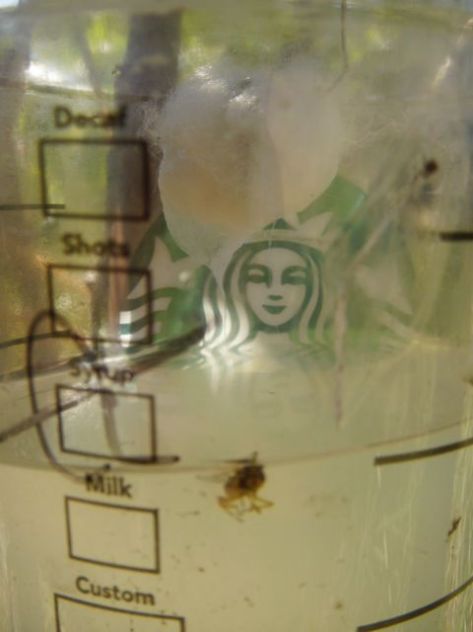
A venti Starbuck’s cup had a second life on the farm as a fruit fly lure. Here in the foreground, a male Oriental Fruitfly (one of 4 species of fruit fly here in Hawaii) floats in a mild soap solution after being lured by the Methyl Eugenol drops that were placed on the suspended cotton ball. A cheap and effective reuse solution. Next…the Melon Fly!