Category Archives: pumpkins

Become a Latin (Language) Lover

Alright, so you may have thought this was going to be a steamier post than it is, so let me explain.  Some of you may have seen those Latin names in the seed catalog, or on the packets and you have simply glazed over due to bad experiences in school.  You may be thinking that you do not need this Latin in your life, and it is just there so to look good.  I encourage you to learn what it means in the context of your garden.  This extra effort may make you succeed beyond measure.  Seed packets have limited space, so we should assume  any information found there is quite important. The packet can begin to lead you to your future success.  So I recommend reading them, but also taking the extra step of understanding what they mean.

This year, before you buy all of your seeds, I ask you to look into the Latin names of the varieties that you want to grow.  It is fun ordering seeds, and heirloom growers get really carried away in our celebration of plant diversity.  You may like to select based on color, or taste, or select to grow only rare plants.  I try a lot of seeds, and test them out each year. The results have been extreme.  My growing history is pretty rough, for every one that succeeded, 20 may have been a total bomb.  Part of that is where I am growing (Hawaii) part is our multitude of microclimates, altitudes, come and go seasons, and drought…or floods.  So what I have decided to do is to stop torturing myself with the “oh maybe this year” denial, and just accept that some will not do well where I am, and others may thrive.  I am an optimist by nature, but enough is enough, and I have to accept defeat when it comes to certain plants. The key to future success is not to stop with a success or failure, but to understand what those results had in common.  That is where the Latin name of the plant comes in.

On “research Sunday,” I stayed awake into the early morning hours as I plotted which varieties I hoped to grow for the season.  I took it one step further than your average grower, by making lists of the plants I grew, then looked up their scientific, aka Latin name. This was the year to reorder chili pepper seeds, but with some doing great, and others performing poorly, I would not allow myself to order another seed, before understanding if there was a trend behind my successes and failures.

I searched for the Latin (scientific) name of the plant variety, then checked several sources to make sure that they were listed as the same name.  Check a few sources, because mistakes do happen.  Two of my favorite vegetables to grow are categorized into more than one species (example squash and chili peppers) compare what varieties(also known as the common name of the plant) are within each species.  Example for the Triamble squash, the species is Maxima, and the variety name is Triamble.  Triamble is what the pumpkin is most commonly called, but Maxima is its Latin (scientific) classification that categorizes its genetic lineage. It is necessary for plant breeders, but it can also lead you to success as a grower because it helps you to understand the relationships between plants.

Chilis are a love of mine, so lets look at how this applies to chili peppers.  Below, you will see two comeback stories. They were plants that nearly died when I was away travelling.  When we look at these peppers, you see that they are very different in their structure.  They are, in fact,  in different species, but both are hot peppers.  The plant on the left shows more vigor, and the plant on the right looks healthy, but rather average, if not below average.  The plant on the right I consider so-so in its production of peppers.  I happen to adore the taste, so I grow the plant, but I would never consider growing these peppers commercially.  The pepper on the left has vigor, and it is putting out triple the blooms of the other plant.  This species seems to really want to live in my microclimate.

I have struggled year after year with Poblano, Jalapeno, Anaheim.  My CA growing buddies sometimes laugh and give me a concerned look, as if I am a chili pepper growing “hack.” But when I mention my success with Ghost peppers, they listen up, because Ghost is one of the most challenging peppers for many to grow.  For one, it needs a very long season to  produce. Secondly, it can be very challenging to germinate. In CA, and beyond, Jalapeno may be one of the easiest to grow, so it becomes confusing, until you look to the species names, and you will see where the line between successful and so-so pepper plants is drawn.

The beauty in plant diversity is that one size, or in this case one seed, does not fit all.  If you are optimistic, you move forward knowing success is out there, you just need to find it. Hawaii farmers are constantly told that we cannot get our production numbers up high enough.  The problem is in part due to the fact that many of the plants that have become commercial “sweethearts” do not grow well in Hawaii.  Yet other plants in other species, thrive, and produce crops. Because of the way our distribution channels work  often times, only the common commercial varieties are seen on the produce order form, so chefs do not use the wonderful, unique fruits and vegetables that thrive here. (more on that is another post) In fact, they may not even know that it grows here.
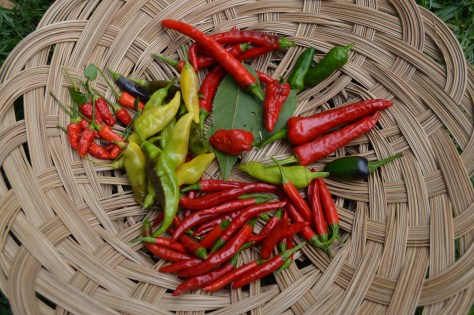
the bounty
Ghost, Thai Dragon, Lemon Drop, Hawaiian, Fish, Cayenne, Banana, Jalapeno

So what I encourage you to do, especially those in Hawaii, is to study what did well (or failed) for you, and then look into its genetic make up.  Are there plant “cousins” that are in the same species that you can also try? To follow with the example, Ghost peppers are in the same species as the pepper image above on the left, Jalapeno is in the same species as the pepper on the right side photo.  So I can be relatively certain that if I select more from the same species on the left, I may have further successes!   I have never felt that the key to agricultural success in Hawaii lies in creating new seeds in a lab, or trying to grow and compete within the narrow scope of commercial hybrids that are shipped in by the hundreds of tons.  Our success is right before our eyes, written in an ancient language.  By learning from our success and our failures, we can make better seed selections in the future,  and we will certainly move forward with confident strides.

So become a Latin lover, and begin the journey of the plant family tree.  You will understand how plants are related to each other, and then maybe explore the possibilities that you may not have tried.  Fail too!  Yes, fail and make note of what did not do well, then use your new research skills to understand that as well.   I say, if we learn from both our mistakes and our failures, we learn twice as fast. Guaranteed, you will love Latin (scientific names) when you have a more successful growing season.  When your harvest overflows, with plants needing so little care, you are going to be happy that you took the time to do a little botanical research. Understanding plant genetics is as easy as reading the plant’s seed packet, or catalog description, so give it a try.

Aloha! and good luck!

Pruning Squash Leaves for Plant Health

I plant close, I’ll admit it, too close.  I am a chronic over planter, but I have my methods.  One is making sure that, as one farmer summed,  ” feed the heck out of your plants.” Yes, I do.  Exactly.  I set those plants up for success by giving them a lot of micro nutrients, worms lolling about, mulch to hold it all in, and you cannot forget my homemade fish emulsion.  Like all good things, success comes from a layering method giving a strong base to grow just about anything.  DSC_0409

So it is mid July, it is now finally hot and sunny in upcountry Hawaii, and my May plantings are beginning to sprawl.  What do I do?  Prune the inner leaves and let the air circulate.  Let the other plants like corn, tomatoes and flowers get to see the light, by removing the squash leaves that are very close to each other.  A healthy squash plant will have “choke” (Hawaii slang for a lot) leaves.  So cut off the ones dusted with mildew, give the bed a good soak with diluted fish emulsion, and let ’em sprawl.  In the weeks ahead, they will smother the entire area where I shot this video.

Bear with the video, it is hot and mid day as I deliver this squinty, yell at the camera squash tip.  But it is sent to you now, so that you can fully benefit from it.  The extra fish emulsion will give it a boost of energy at week 6, a heavy vining time in the squash’s life cycle.  So prune, put the leaves in hot compost so to rot it down.  Don’t leave the leaves in the garden or you will encourage the powdery mildew.  Bag the leaves in an old garbage bag, tie it shut, leave it in the sun to cook and kill the mildew before moving them to your compost.

I happen to breed varieties that are naturally resistant to Hawaii’s bouts of mildew, they are often unaffected, when a new trial plant is suffering in it’s first season.  Only the strong plants survive my plant editing.

Powdery mildew is common here in Hawaii, even in dry up country.  I mean very common.  If a plant is getting a lot of natural nutrients, good air circulation, sun and water, don’t fret, maybe try a different species or variety of squash.

Only a small percentage of the squash varieties that I trial even like their VIP care.  So many varieties simply don’t like growing here.  Hawaii has a little bit of everything pests and disease, with the highly unpredictable growing conditions for plants, none of which is welcomed by many squash varieties.  I tried to grow the super dependable Hubbard, and it didn’t like the farm conditions at all.  Now that the soil is really soil instead of half rotted compost, it may like it.  Sometimes it is the time of year that you plant, or even the day that you choose to plant on.  If at first you do not succeed, try again.  You will be a better farmer or gardener if you fall on your face a few times.  Trust me. I do it all of the time.

Try (New Things)

What if you thought that you couldn’t grow tomatoes or melons, or pumpkins, only to find out that you could have all along? A lot of Hawaii gardeners begin by thinking of mainland season, and mainland vegetables, Soon they watch their dreams fizzle as plant after plant fails. I read and respond to so many messages where all I can do is encourage experimentation, research, and expand your tastes. All kinds of plantings are possible, but sometimes, you have to be the one to figure out those possibilities. Now, so many of us have websites that can hopefully cut your research down by several seasons, if not years,  But due to micro climates, what works for me may not work for you, or maybe it will.   Often we must just try and see.  Many just want answers, they just want seeds, while others are problem solvers and researchers.

DSC_0964

Think it cannot be done? It can, trust me on that one.  We are now mining history for seed solutions that have been solutions for many generations. They have just been pushed out of popularity due to commercial interests. It is not too late.  The Internet connects growers and seed savers from around the globe.

hidden Marina Di Chioggia Possibilities are being rediscovered every season. So give it a try, and see if you can find your own solutions.  Inspiration is contagious.

DSC_0404

Preparing to travel to Baker Creek Headquarters for the Spring Planting Festival

I am a bit nervous as I prepare to leave the farm for 7 days so to be an active participant of the Baker Creek Heirloom Seeds Spring Planting Festival.  http://www.rareseeds.com/spring-planting-festival/ It will be taking place at their Missouri headquarters on Sunday and Monday, May 3rd and 4th. Forgive the fact that I say Sat and Sunday in my video…It is Sunday and Monday, and I am a bit giddy about the whole thing.  I will be giving two talks now, one on Sunday and one on Monday.  I am most grateful and excited to be going.DSC_0420

So now, aside from saying the wrong days in the video, the rest is good information, that I hope you will enjoy.  How do you get ready to go especially when it is prime time to be farming here in Hawaii?  Take some small, but strategic steps toward starting seedlings, so that they are ready to go upon your return.  I use reclaimed basalt blocks that are cut down and soaked in water.  Each will hold one squash seedling, and they will make it so that minimal disturbance to the root system will take place at transplanting.  Squash generally do not like to be transplanted…so this is a real happy success to share.  I have increased both productivity, and my germination speed by this method.  So sit back and enjoy, and maybe I will see you on Sunday or Monday there at the Spring Planting Festival!

The Return of the Waimea Farm Fair

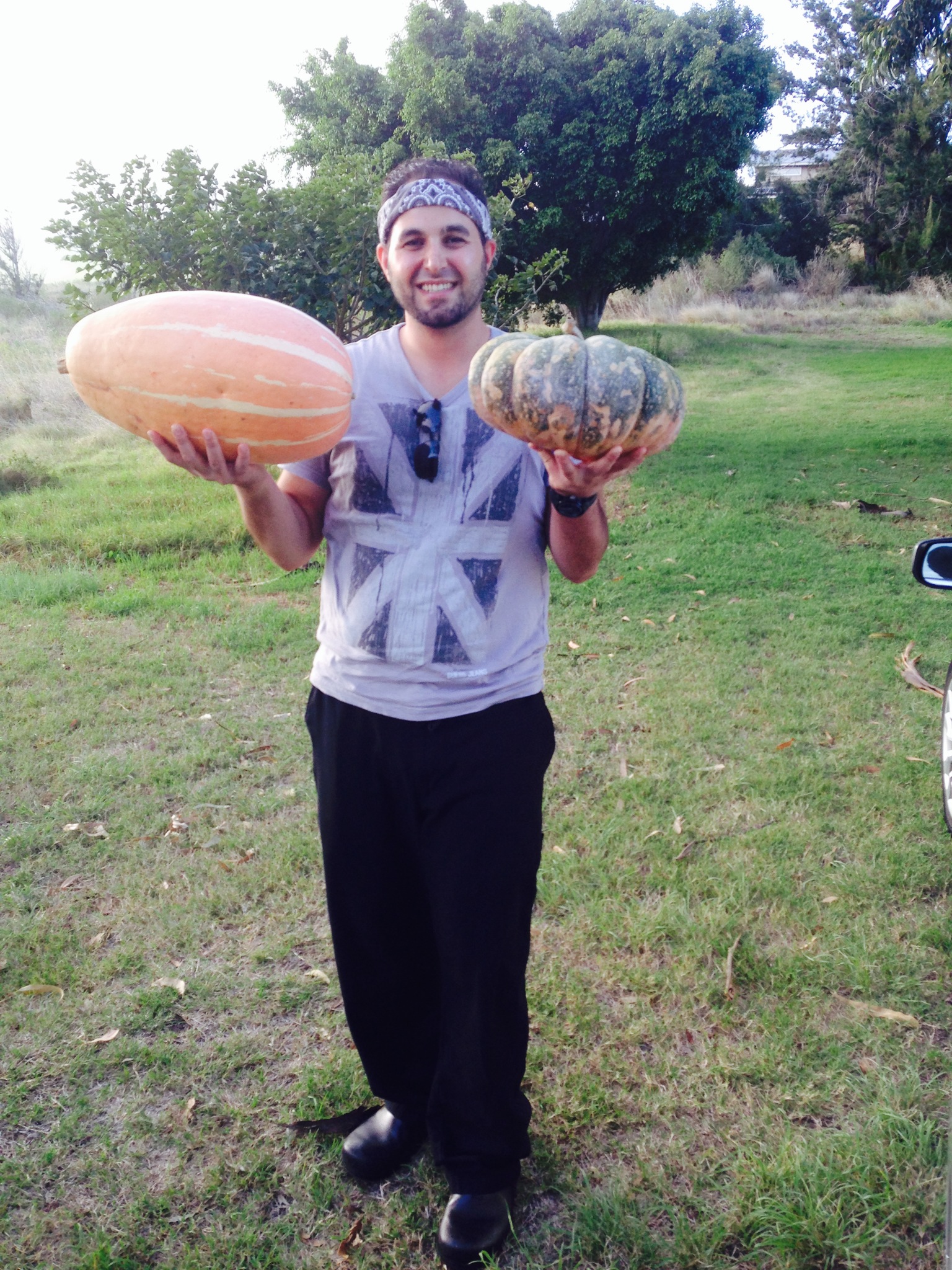
After 20 years, the Waimea farm fair returned this year.  Expanding on the giant pumpkin growing contest of years past, this year brought tomato tasting and pumpkin cooking elements as well. I may max out at a 45lb squash, so no “giants” for me, but I do love to celebrate with the growers.  It is a squash solidarity.  You do not understand patience until you grow squash in Hawaii.

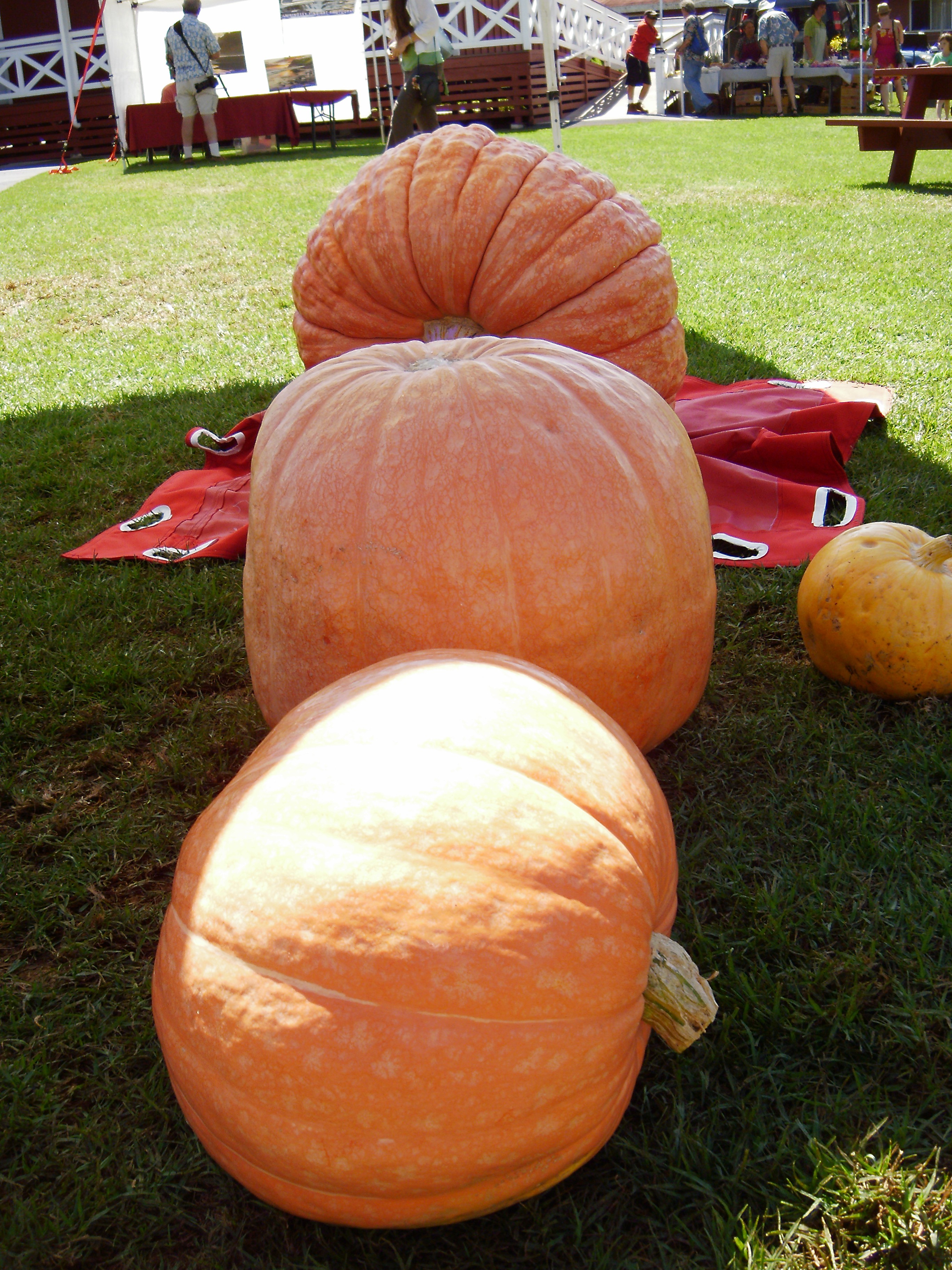
All beautiful and worthy contenders  Pumpkin and squash can be tricky here and Hawaii, and our giants can vary by hundreds of pounds from season to season.  But that isn’t the point, the point is that community gathered to celebrate nature, ambition, and the pure dedication that it takes.  HPA school entered three very different pumpkins that helped to illuminate how different pumpkins from the same patch can be.  The Largest at rear of photo took 1st in the school garden category) Soil maverick and giant pumpkin grower Noah Dodd led the way for HPA by using his own unique soil microbe building methods to get the squash to grow to super sized proportions.

Donna Mitts and prize winner Myrtle

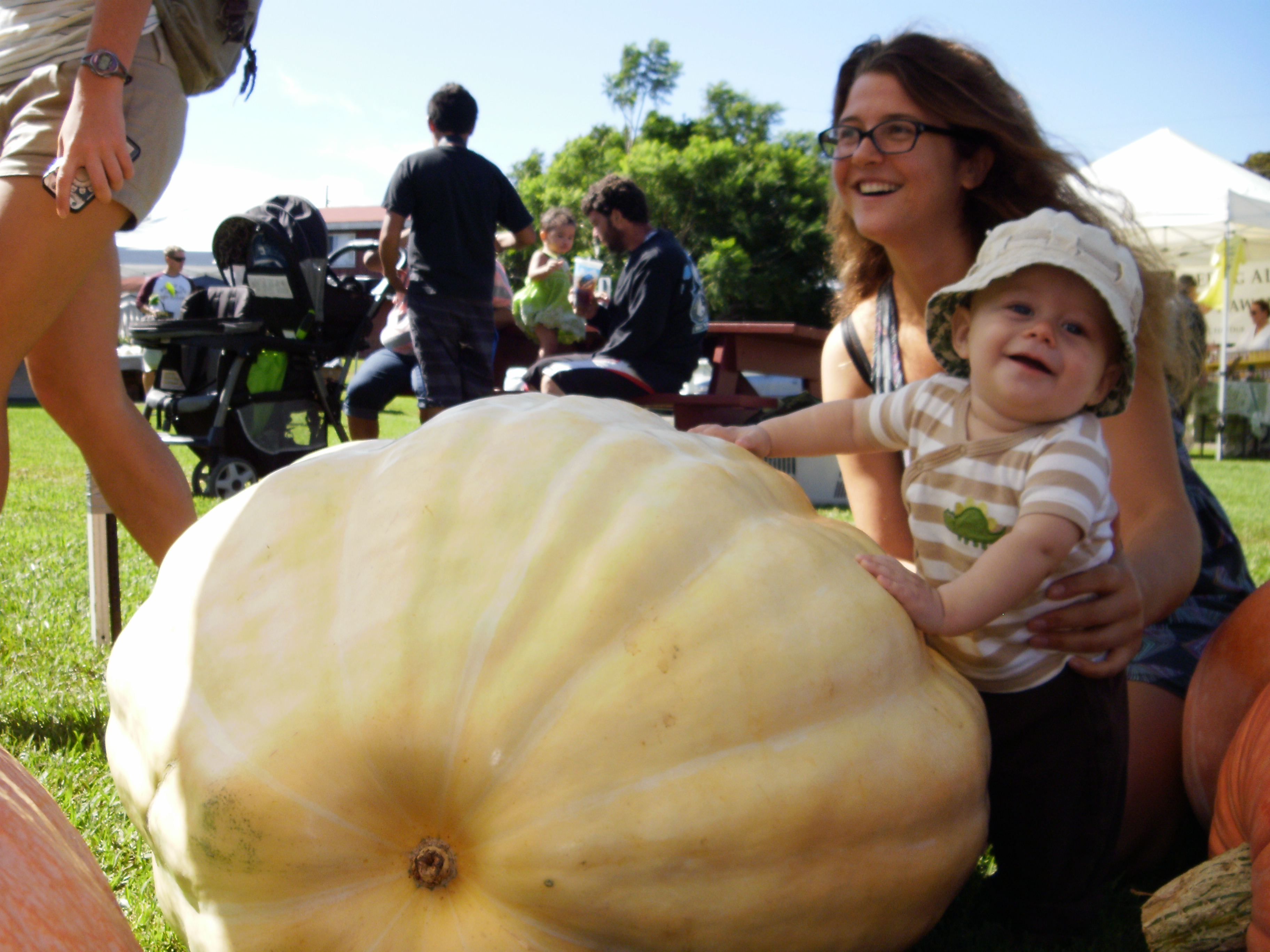
I know and respect organic grower Donna Mitts, who has been giving me updates throughout the season. ( see image above) Her squash was golden and beautiful, and very deserving of the attention that it got.  She named the squash Myrtle, and it grew into it’s name.

Future grower Baby Max

Baby Max showed the enthusiasm that we all felt.  Here Max celebrates Donna’s pumpkin. Council woman Margaret Wille joined Donna Mitts and myself in a photo among the giant pumpkins.  Chefs and home cooks alike marveled at the culinary possibilities.

The Winters Ohana shined

Young Kawika Winters himself weighed in at only 1/2 a pound more than the giant pumpkin that he grew.  Here he awaits the judging  flanked by the other contenders.

Donna Mitts grew "Myrtle" organically
Donna Mitts grew “Myrtle” organically

Ribbons were awarded in many categories, including record keeping for the school gardeners.  How wonderful to reward a quieter, but valuable dedication. Mala’ai School garden won the record keeping prize by creating a beautiful photo log that captured the season. http://www.malaai.org

Cooking Contest

After the celebrations for giant pumpkins, we moved on over to the tomato tasting and pumpkin cooking competition.

tomato tasting station

The tomato judging begins

As the judging took place, many of us marveled at the challenges of comparing the beautiful island grown produce.  We were very happy to see some of our islands best including the innovative Chef Sandy that were part of the judging crew.

Ice cold pumpkin juice
refreshing pumpkin juice

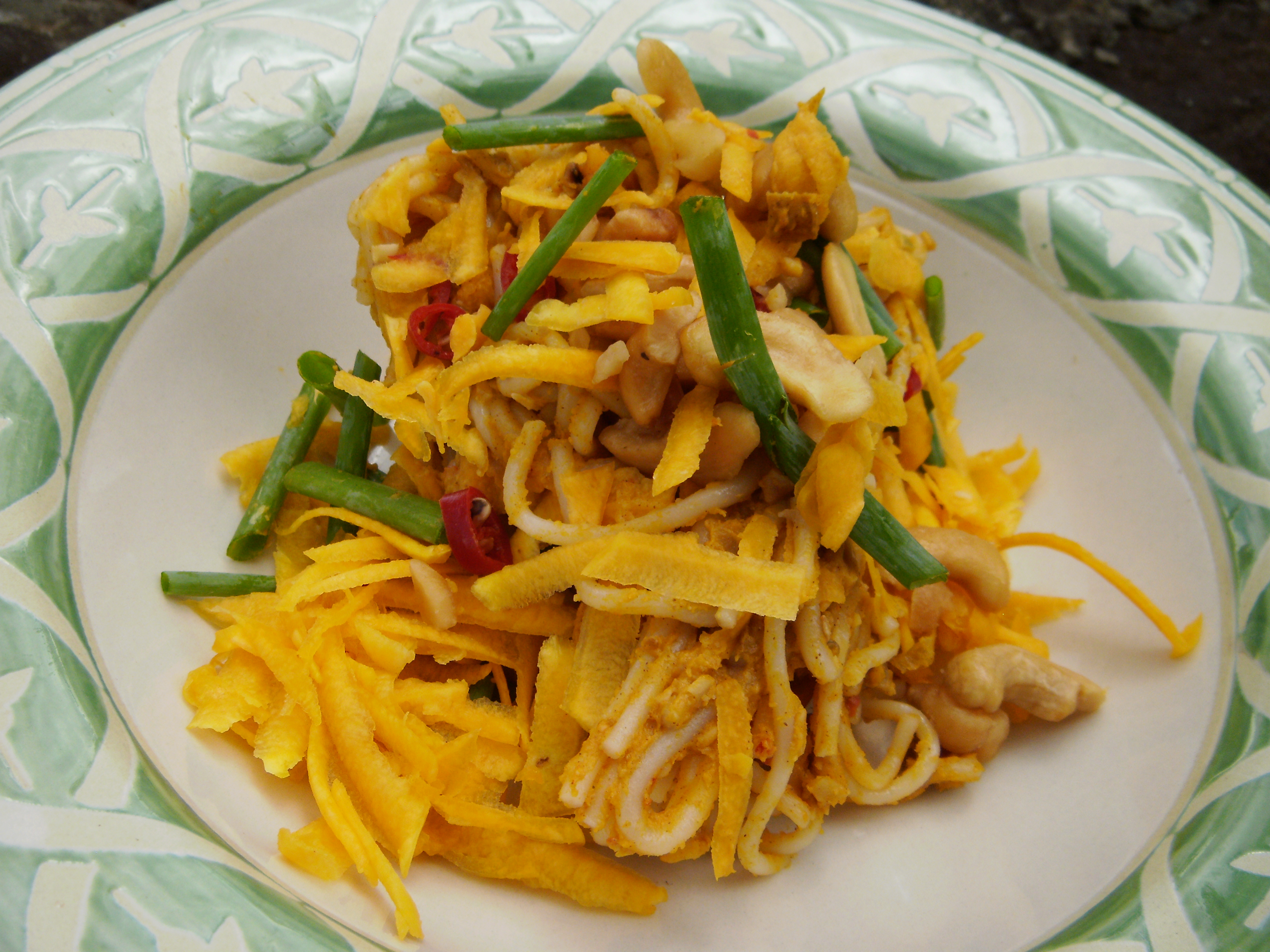
Then more talk of pumpkins.  Donna Mitts wore many hats throughout the event including making the wonderful and refreshing “Pumpkin Juice” that cooled us under the hot Waimea sun.  She used pumpkin puree, apple juice and pumpkin pie spice to make this welcomed treat.  Then came the judging of the pumpkin cooking contest.  Many of us were nervous as the judges buzzed around through plate after plate of homemade, beautiful food.  There were three categories, including Main course, desert, and misc category.  Pumpkin butter, pumpkin curry, pumpkin tortellini, pumpkin nut bread, pumpkin casserole, pumpkin chiffon pie, pumpkin crumble, and my dish Pumpkin Noodle Nut.

My Pumpkin Noodle Nut dish
My entry in the line up

I am not sure why I was nervous with such a wonderful mix of people celebrating food.  But when farmer/organizer Paul Johnson and the judges gave the “all clear sign” that the crowd could sample all things squash, my tension eased, as we laughed and nibbled the plates clean.

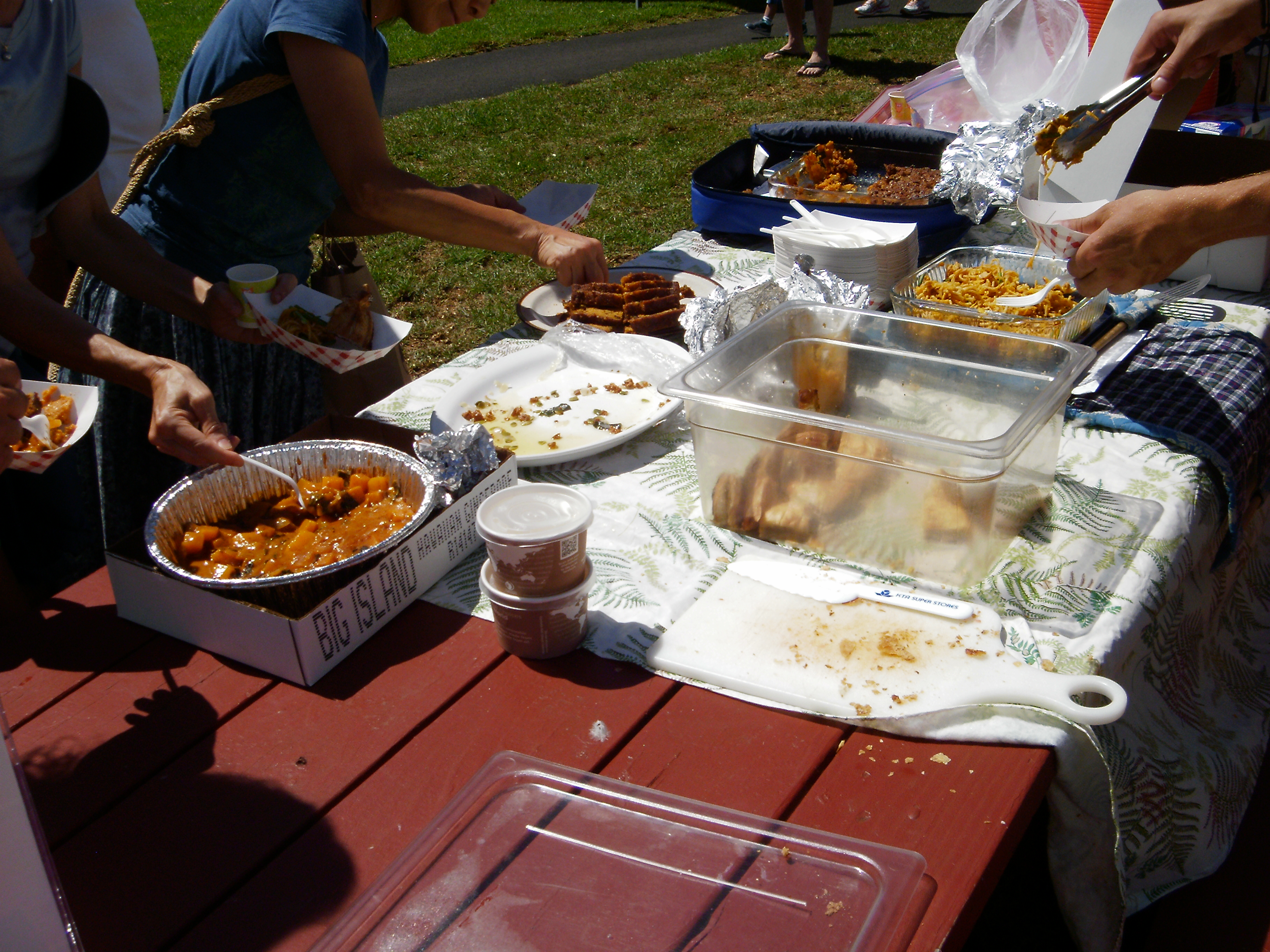
Storming the table after judging
Guilty! We pounced on the table.

I mean we really went for it.  Each dish was special, and made with love.  We celebrated local ingredients and family recipes.

Paul reappeared as a wizard

Paul was a good sport, and surprised us all by reappearing in costume.  The kids loved it!

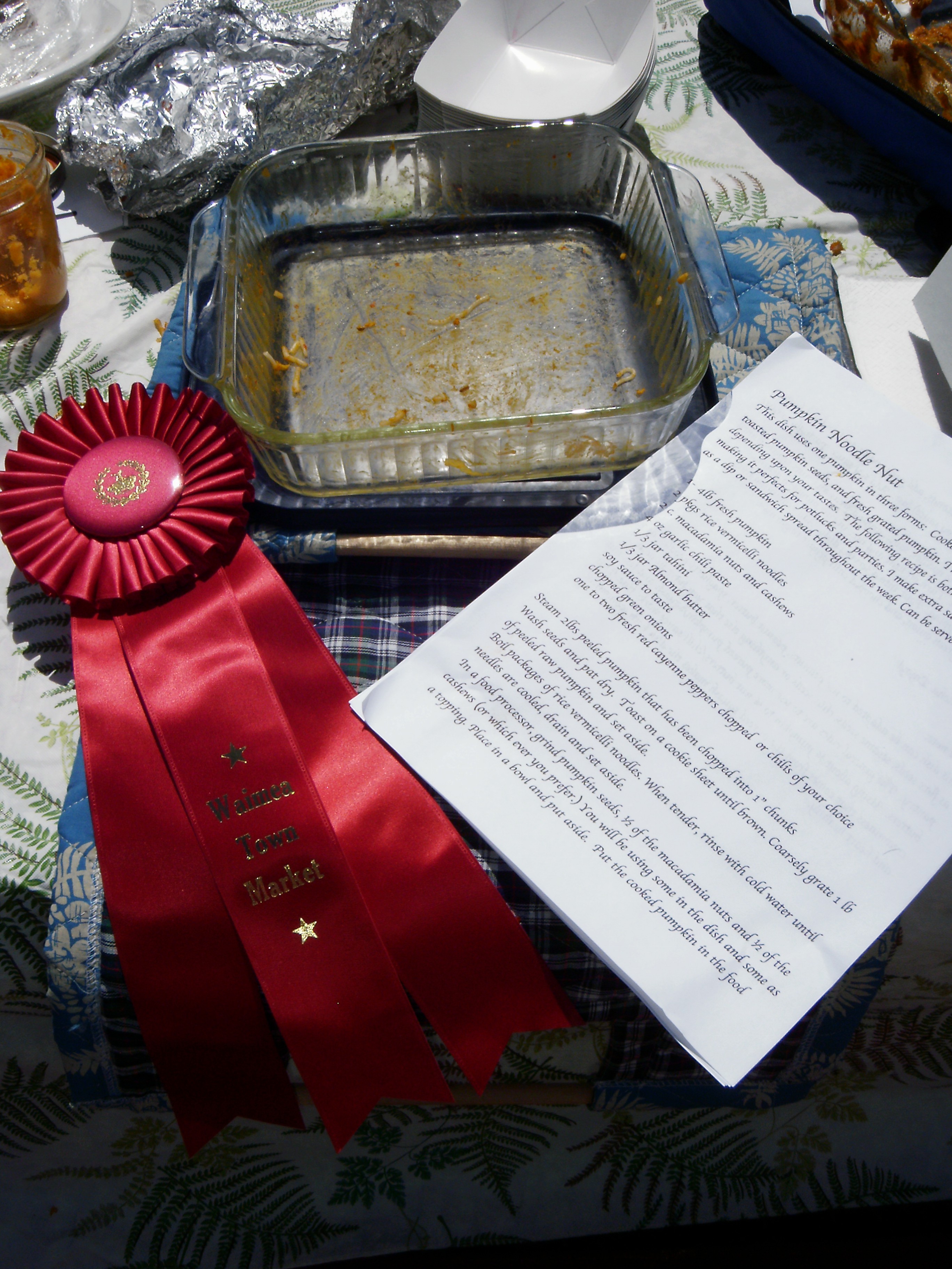
Clean plate club and 2nd place ribbon
A clean plate, a red ribbon, and the recipe to share

Then the prizes were announced by category. I would not have been a very good judge, because, each one was so wonderful.  It was like picking puppies or kittens.  The unique dishes were creative and flavorful, and many were very nutritious as well.

I took a risk by entering a brand new recipe to the contest.  I wanted to showcase squash as much as possible in one dish.  I had made a gluten free, vegan recipe called noodle nut last year.  After meeting with Chef Stephen of Under the Bodhi Tree restaurant in the shops of Mauna Lani http://www.underthebodhi.net  I was inspired to try new things.  So I changed my existing recipe to include cooked pumpkin puree, ground toasted pumpkin seeds, and grated fresh pumpkin.  Chef Stephen does raw and vegan entrees, and also loves to use pumpkin seed.  Pumpkin is so versatile, so I thought…heck go for it, this is the only pumpkin contest we have ever had on the island, so I thought it is time to pull out all of the stops.

So just a day before the contest, I was revamping and “pushing the pumpkin” into the recipe, and I am so glad I did.  Using all gluten free and vegan ingredients, my home grown black pumpkins, home grown cayenne chili peppers, Pat Hall’s aquaponic grown green onions, and local macadamia nuts.  It was an island proud dish.  The empty dish says it all.  It was cleaned out and awarded a 2nd place ribbon in the main dish category. Third went to the lovely pumpkin curry, and first place went to one of our island’s best chefs, Executive chef James Babian.  Chef Babian was the Executive chef of the Four Seasons resort here on the Big Island.  He can be credited with helping to move the buy local movement here over a decade ago.  He makes his own pasta from scratch in the kitchen of the restaurant that he and his wife Christine created in Waikoloa village named Pueo’s Osteria. http://www.pueososteria.com   Go there, trust me.

Let’s just say if anyone deserves first place, I have to say it is him.  I managed to get one lone tortellini off the plate before the other tasters descended.  It was divine, and sort of melted in your mouth.  I feel lucky to have gotten one, and no, I have no photos, because it was either grab one, or photograph it.  So sorry blogosphere, but eating won.  It was that good.  But watch out Executive Chef Babian, I’ll be back next year with another year of pumpkin cooking under my belt.  I’ll do my best to take on your tortellini again..or at least be quite ready to again grab one off the tasting plate.

Mahalo to all those who attended, volunteered their expertise, and added their talents to the day.  We all love a good come back story, and what better come back than that of the community farm fair.

OLYMPUS DIGITAL CAMERA
My Pumpkin Noodle Nut

Team Downey Sourced all Things Hawaii

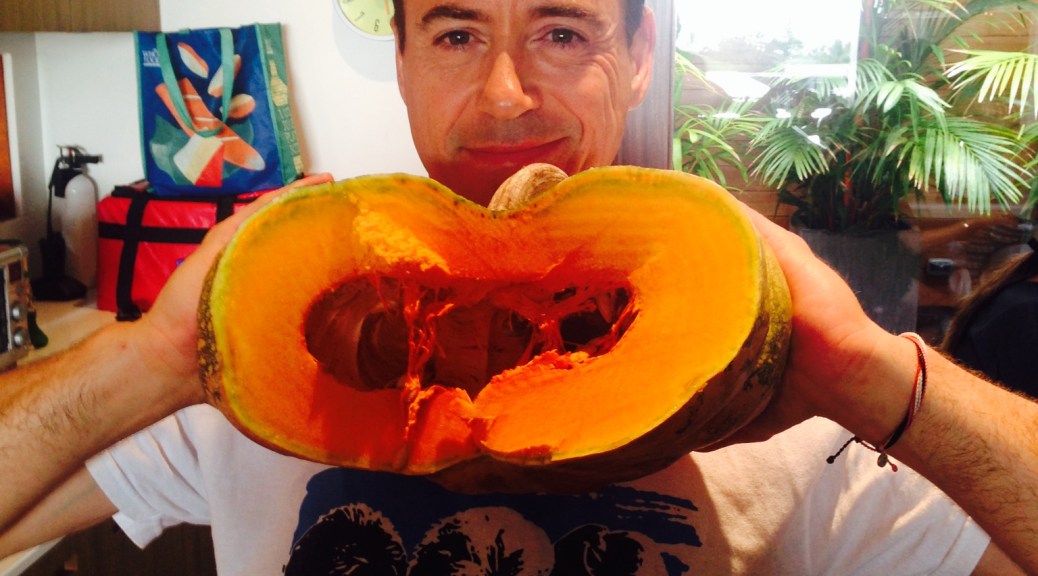
Heart is skipping a beat or two at this image of Robert Downey Jr and my Thai Rai Kaw Tok heirloom squash. They both look great! Mr and Mrs Downey, Chef Charles Voudouris, and the entire Team Downey posse made a noble effort to source all that was local, ethically produced, and sustainably grown.

Farmer hat off to you all! Mahalo nui loa.

Hawaii farmers appreciate your efforts!

Chef Charles Voudouris of Team Downey visits the farm

It was a pleasure to have Chef Voudouris of Team Downey visit the farm last evening!

Chef Charles

He has just arrived, but he immediately set out to travel the island to source high quality fish and produce direct from our fishermen and farmers. His smile reveals his excitement in experiencing what is new (or in the case of heirlooms-old) on our farms. Here visiting the isle, Chef Charles is the private chef for Team Downey who are on island for the next two weeks. When presented with the table of rare heirloom squash, Chef knew immediately which one would be taken back to the kitchen, it was the Thai heirloom Rai Kow Tok.

image-3

image-4

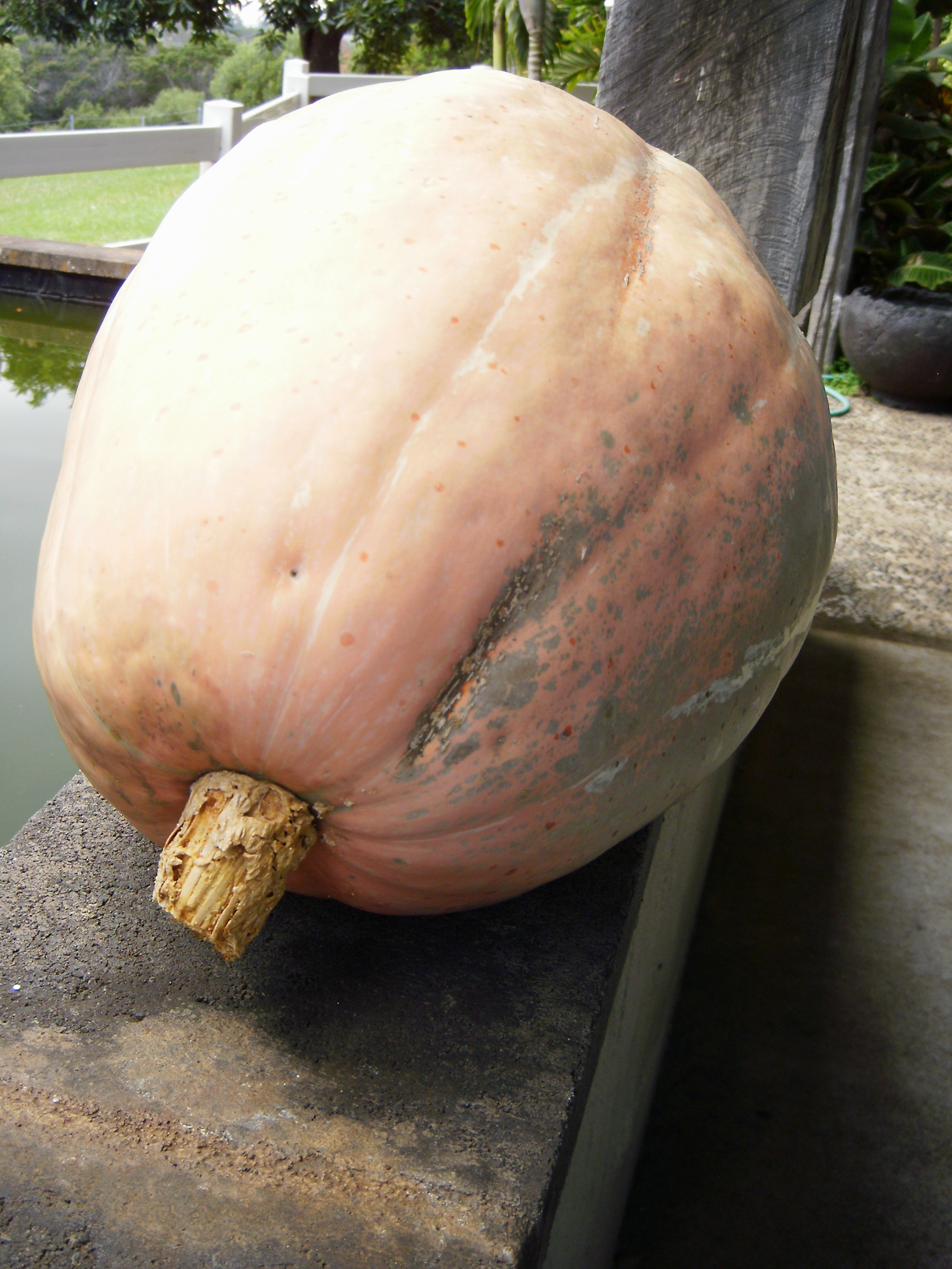
This is the first season that I am growing the lovely, dappled Winter squash. The 20 lb c. moschata variety thrived here in Waimea’s challenging environment. Without missing a beat, Chef Charles had the recipe worked out before even setting the produce in the trunk of his car.

It was so nice to have him visit the farm, to share in his stories and insight, as well as take these beautiful farm photos. I was happy to hear that Team Downey is dedicated to finding sustainable produce, and that they frequently enjoy vegan meals. It is an honor to have my squash be a part of their island experience. I wish the team a wonderful visit, and a big mahalo for allowing us small farmers to take center stage at the dinner table.

Mahalo nui loa Chef Voudouris and Team Downey, you are welcome back anytime!

Teaching With Food

PA111272

I remember working very hard to earn my Girl Scout cooking badge. Though that may seem dated to some, learning through food is all the rage once again in our schools. Last year I had the great opportunity to peer into our island classrooms, school gardens, and pre-k daycare centers. I got to have a lot of one on one talks with teachers and child care providers about what is lacking in the children’s food. I learned that all pre-k classrooms have to have a certified kitchen on property. That may mean little to most people, but to me, it said opportunity. What better place to launch a food movement than to the little ones who are so eager to learn…and eat. So that is what happened. I took it upon myself to figure out how to teach the 4 year old set how to make something to eat. The result, happy young chefs that were happy to “feed themselves” something that they made themselves and as bright and tasty as a pumpkin pie smoothie (see Vegan squash smoothie recipe.) It was so much of a hit that I am expanding it this year. Who doesn’t want their child to help out in the kitchen and have a little more time with you? Be on the lookout for more of my mini chef classes to be offered this fall. Want it to come to your kid’s classroom? Sponsor a class at the school of your choice. See my funding page http://www.gofundme.com/squash-and-awe for more details.