
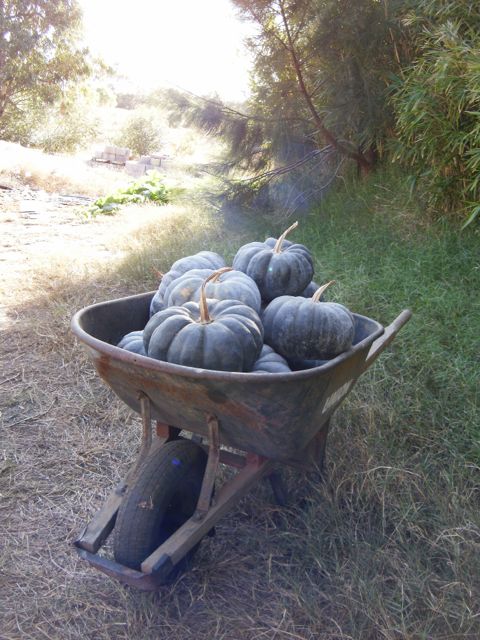


Non-GMO legislation passed on Hawaii Island
I haven’t mentioned this on the site as of yet, but it is important to do so. After much debate, the Mayor passed the legislation on behalf of the farmers, the Native Hawaiians, and the many concerned citizens of the state and beyond. It is hard to sum up the importance of this legislation for me personally, but I will try. I wrote two testimonies and delivered one in person. It was terrifying for me. I get stage fright, so delivering testimony was one of the hardest things I have ever done. But I had to get it together and look beyond myself to see the power in numbers, and stand tall. On a practical level, it was also completely necessary for me to do because GMO squash would wipe me out. GMOs have the potential to wipe out many who are organic. You loose you Organic certification if your fruits/veg test positive for GMO. Believe it or not, some non organic farmers tried to say that that wasn’t a very big issue. Loosing your certification/foreign markets due to your neighbor’s actions would probably be a pretty big deal to most people.
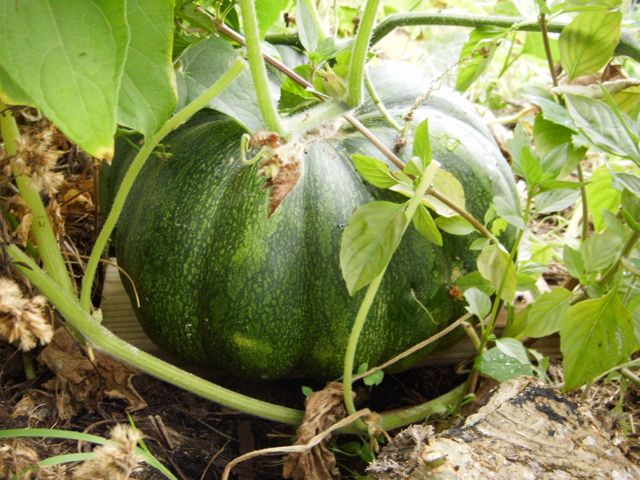
For me personally, it allows me to continue to grow squash without cross pollination with GMO varieties. Squash is one of the most susceptible to cross contamination, and since bees travel many miles, it is almost impossible to control without close pinning shut each and every bloom (not possible on this scale that I am growing.) Different varieties of squash all cross with each other so that without a shutdown of GMO seeds, GMO squash would quickly cross contaminate the existing squash farms, and wipe out all local squash varieties, and we have no local seed bank to go to. It allows me to continue to offer pure strains of pumpkins that were in the hands of our ancestors. It allows me to know what I am growing, and to be proud of what I am doing with my life. It allows me to expand my farming efforts, and celebrate the uniqueness of our isolated island environment. It allows me to offer non-gmo squash and pumpkins from Hawaii all of which are grown in hand built soil using organic methods.
This is just what is on my mind right now. It is like the skies opening after the rain. It is possibilities for the future of farming, of reclaiming sustainable methods, and feeding our families right. It sets us apart from the rest of the state in the best possible way. The Big Island is now a leader. OK off the soapbox.
Related articles
- Hawaii passes bill forbidding biotechnology companies, GMOs (naturalcuresnotmedicine.com)
Second Chance in the Composting Beds


Here is an example of a new “tropical composting bed method” that I am trying to invent. Will it work? For sure…well with enough time, all composting works if you add a big range of materials. Here are the zero-waste salvage materials found on the farm, and donated by Redwater Cafe.
Border walls: basalt growing blocks salvaged from a greenhouse
Base layer: ocean fish scrap
Second layer: green veg waste and egg shells
Third Layer: fairly well broken down Ironwood needles
Fourth layer: coral sand
Fifth layer: a dusting of soil from the farm
more layers to follow…
to be continued…
Fish Emulsion Underway

So there are three buckets of varying sizes, all draped in cotton t-shirt material, sitting in the far back corner of the work shed. The scent is slightly warf-esque, but not too bad. This is week two. I am using a modification of Korean Natural Farming’s fish emulsion (natural fertilizer) method of layering fish with sugar to create a stock nutritional solution for the plants. Each bucket is a trial. One uses whole fish heads from Ahi, Mahi Mahi, and Snapper, one uses only the belly meat, and the last was done properly by chopping all with a machete before layering. 100% of the fish were rescued from the landfill by the helpful local chefs who allowed me to intercept and make use of the restaurant scraps. I am checking to see what the breakdown rates are here in the tropics. So far so good. Many Mahalos to John for assisting in the “properly made” batch. I am using reclaimed plastic pails, but glass or ceramic is preferred. I may have overdone the sugar…but we will see what happens.
to be continued…
Every Creature is Loved at the Farm
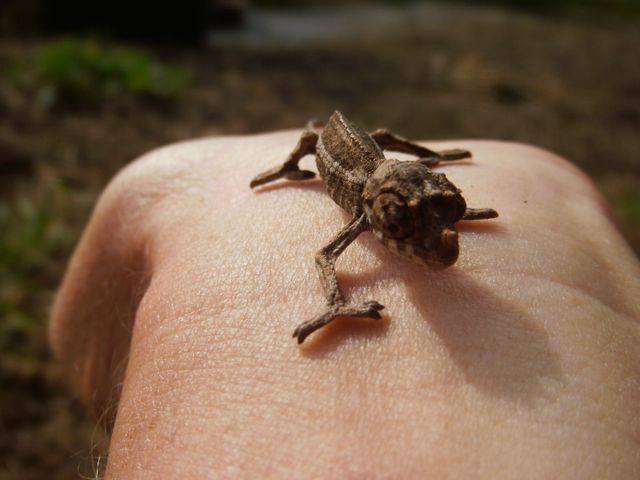
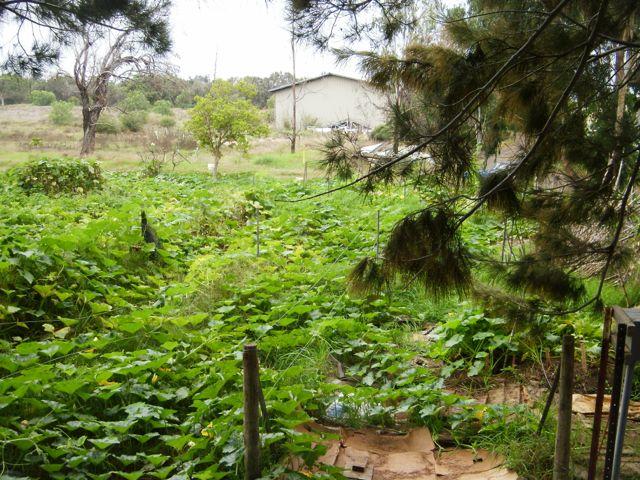
When walking the Ironwood lined path behind the squash vines, this tiny man was found working his way home. Beautiful and independent, I let him go again so that he could return to his tall tree home.
Zero Waste Farming
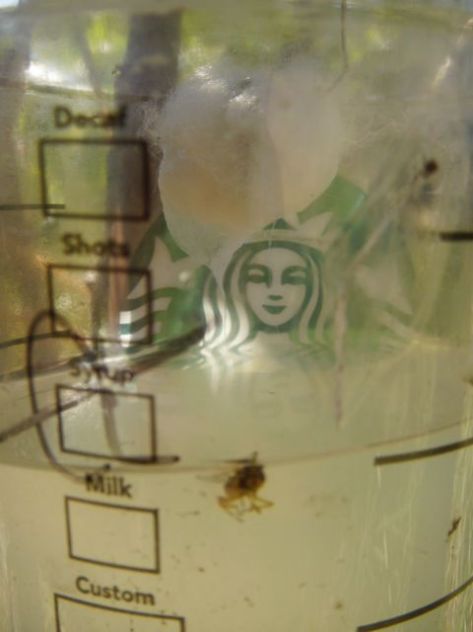
A venti Starbuck’s cup had a second life on the farm as a fruit fly lure. Here in the foreground, a male Oriental Fruitfly (one of 4 species of fruit fly here in Hawaii) floats in a mild soap solution after being lured by the Methyl Eugenol drops that were placed on the suspended cotton ball. A cheap and effective reuse solution. Next…the Melon Fly!

Fish composting and fish emulsion
This week feels like two. It is a hot week here in Hawaii. What better time to be carting about my body weight in fish heads? Yes, you heard me. Alright, so it isn’t an ideal time to be working with raw fish, but opportunity knocked, and I answered. The theme of the week is to make use of even more restaurant waste. What better place to make the most of the discarded fish bits from our beloved Ahi and Mahi Mahi? The Chefs have set me up with enough fish heads to enrich the new farm addition. I am getting my composting game in overdrive with the gloves pulled up high for this messy week….but I am ready and grateful for the challenge. And it should also be noted that I say a small prayer of gratitude for each fish that is added to the soil building project.
Fish composting and fish elulsion making are on the adjenda.
Organic no-till, sheet mulching, lasagna gardening
It takes a lot of time up front in the collection of mulch materials, but the big gain is that your squash plants can feed for months on the rich nutrients that you have made for them. I plant when the bed is new. That is not ideal, but it allows me to hit production faster. Being in Hawaii, our composting beds age quicker than in cooler climates. By the time the pants are two to three months old, the beds are beginning to break in…by six months (squash grow year round here if you work hard) the beds are getting rich and crumbly.
Dream Keeper- A new Hawaii grown variety
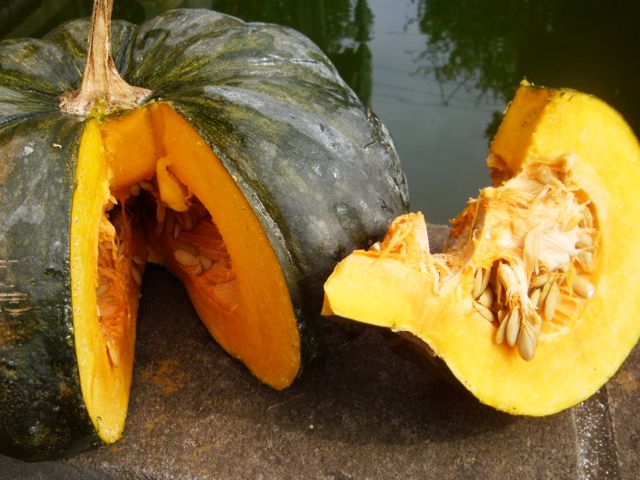
Dark green, with light green and gold freckles, Dream Keeper is a new organic squash that I created by cross-pollinating two strong C. Moschata strains. The result…a beauty that is virtually mildew and bug proof without sprays. On the inside she is as gorgeous as a Hawaiian sunset.
Sometime in my lifetime, many farmers forgot how to build soil
For hundreds of years, farmers built the soil as a foundation for the food that fed their families. A foundation for their future. A built-in daily vitamin for themselves that would be harvested in the months ahead. Then something happened when I was still measured in relation to my Gandpa’s knee. There were better ways, they were told. Better? Faster, more….but really it was the point of diminishing returns. More lackluster crops were produced in greater numbers. A strong line was drawn. Agricultural crops were now treated very differently from vegetable gardens. Farmers seemed to hang on to the build the soil method in the vegetable patch that fed their family, and in times of need, their neighbors. Why was that? Was it because that was the domain of the woman of the house? She held onto these methods that are methods that organic farmers still use today. Rotating, covering, mulching…So was it scale that was the issue? Probably. In the never-ending American push that bigger was better, we learned quite late that bigger was simply bigger. And the “better crop” was in the farmer’s own veggie patch.
 Squash and Awe