


A little bit of everything, these past couple of weeks. Newness, recovery, rain (!!!,) and potential, were everywhere.
A little bit of everything, these past couple of weeks. Newness, recovery, rain (!!!,) and potential, were everywhere.
Alright, so you may have thought this was going to be a steamier post than it is, so let me explain. Some of you may have seen those Latin names in the seed catalog, or on the packets and you have simply glazed over due to bad experiences in school. You may be thinking that you do not need this Latin in your life, and it is just there so to look good. I encourage you to learn what it means in the context of your garden. This extra effort may make you succeed beyond measure. Seed packets have limited space, so we should assume any information found there is quite important. The packet can begin to lead you to your future success. So I recommend reading them, but also taking the extra step of understanding what they mean.
This year, before you buy all of your seeds, I ask you to look into the Latin names of the varieties that you want to grow. It is fun ordering seeds, and heirloom growers get really carried away in our celebration of plant diversity. You may like to select based on color, or taste, or select to grow only rare plants. I try a lot of seeds, and test them out each year. The results have been extreme. My growing history is pretty rough, for every one that succeeded, 20 may have been a total bomb. Part of that is where I am growing (Hawaii) part is our multitude of microclimates, altitudes, come and go seasons, and drought…or floods. So what I have decided to do is to stop torturing myself with the “oh maybe this year” denial, and just accept that some will not do well where I am, and others may thrive. I am an optimist by nature, but enough is enough, and I have to accept defeat when it comes to certain plants. The key to future success is not to stop with a success or failure, but to understand what those results had in common. That is where the Latin name of the plant comes in.
On “research Sunday,” I stayed awake into the early morning hours as I plotted which varieties I hoped to grow for the season. I took it one step further than your average grower, by making lists of the plants I grew, then looked up their scientific, aka Latin name. This was the year to reorder chili pepper seeds, but with some doing great, and others performing poorly, I would not allow myself to order another seed, before understanding if there was a trend behind my successes and failures.
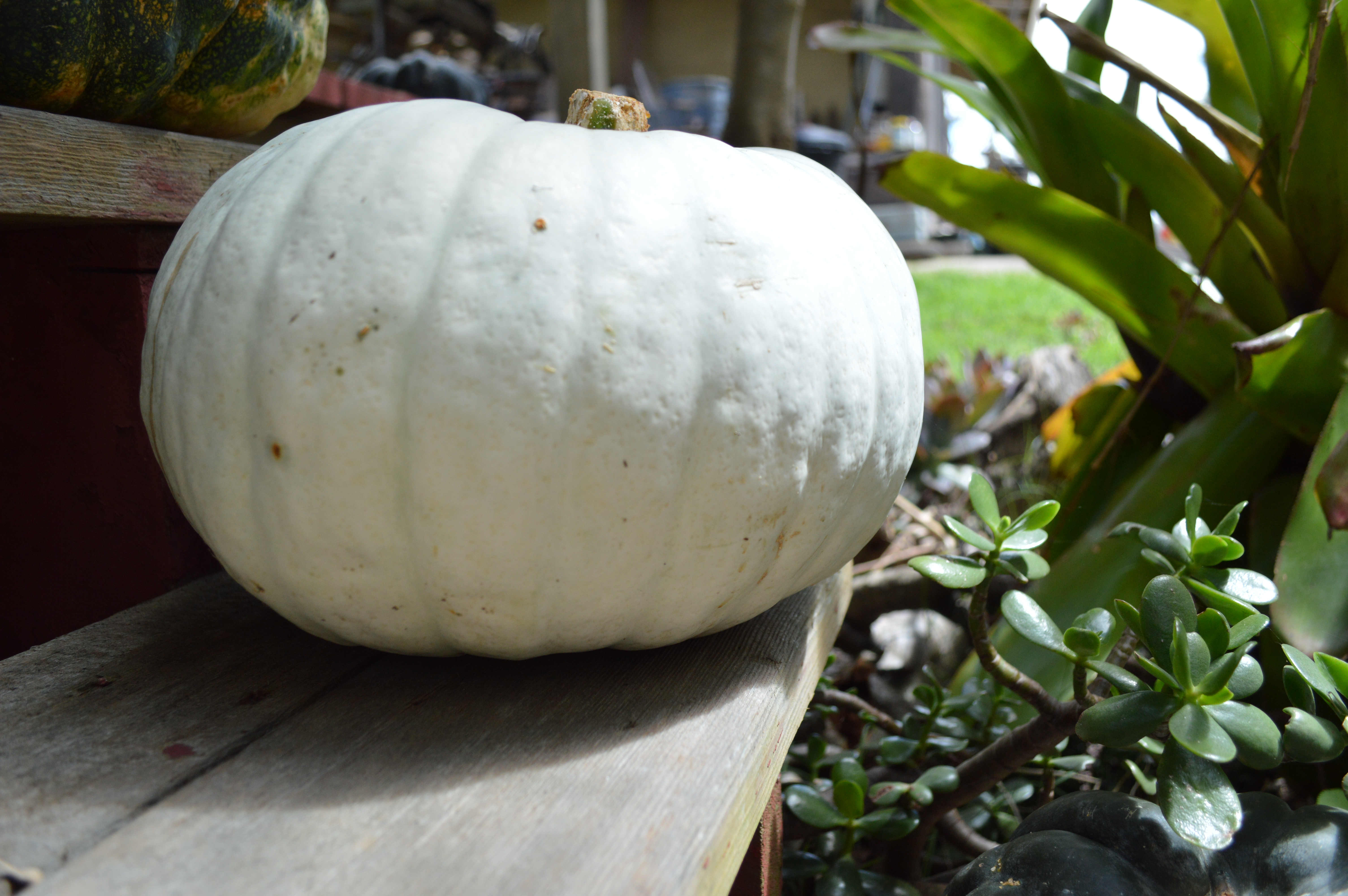
I searched for the Latin (scientific) name of the plant variety, then checked several sources to make sure that they were listed as the same name. Check a few sources, because mistakes do happen. Two of my favorite vegetables to grow are categorized into more than one species (example squash and chili peppers) compare what varieties(also known as the common name of the plant) are within each species. Example for the Triamble squash, the species is Maxima, and the variety name is Triamble. Triamble is what the pumpkin is most commonly called, but Maxima is its Latin (scientific) classification that categorizes its genetic lineage. It is necessary for plant breeders, but it can also lead you to success as a grower because it helps you to understand the relationships between plants.
Chilis are a love of mine, so lets look at how this applies to chili peppers. Below, you will see two comeback stories. They were plants that nearly died when I was away travelling. When we look at these peppers, you see that they are very different in their structure. They are, in fact, in different species, but both are hot peppers. The plant on the left shows more vigor, and the plant on the right looks healthy, but rather average, if not below average. The plant on the right I consider so-so in its production of peppers. I happen to adore the taste, so I grow the plant, but I would never consider growing these peppers commercially. The pepper on the left has vigor, and it is putting out triple the blooms of the other plant. This species seems to really want to live in my microclimate.


I have struggled year after year with Poblano, Jalapeno, Anaheim. My CA growing buddies sometimes laugh and give me a concerned look, as if I am a chili pepper growing “hack.” But when I mention my success with Ghost peppers, they listen up, because Ghost is one of the most challenging peppers for many to grow. For one, it needs a very long season to produce. Secondly, it can be very challenging to germinate. In CA, and beyond, Jalapeno may be one of the easiest to grow, so it becomes confusing, until you look to the species names, and you will see where the line between successful and so-so pepper plants is drawn.
The beauty in plant diversity is that one size, or in this case one seed, does not fit all. If you are optimistic, you move forward knowing success is out there, you just need to find it. Hawaii farmers are constantly told that we cannot get our production numbers up high enough. The problem is in part due to the fact that many of the plants that have become commercial “sweethearts” do not grow well in Hawaii. Yet other plants in other species, thrive, and produce crops. Because of the way our distribution channels work often times, only the common commercial varieties are seen on the produce order form, so chefs do not use the wonderful, unique fruits and vegetables that thrive here. (more on that is another post) In fact, they may not even know that it grows here.
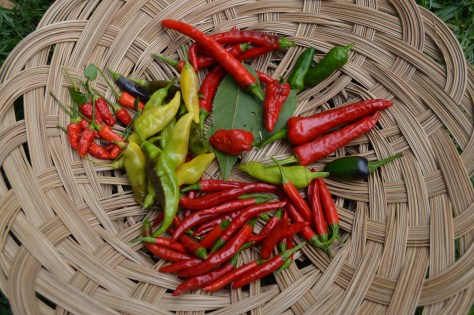
So what I encourage you to do, especially those in Hawaii, is to study what did well (or failed) for you, and then look into its genetic make up. Are there plant “cousins” that are in the same species that you can also try? To follow with the example, Ghost peppers are in the same species as the pepper image above on the left, Jalapeno is in the same species as the pepper on the right side photo. So I can be relatively certain that if I select more from the same species on the left, I may have further successes! I have never felt that the key to agricultural success in Hawaii lies in creating new seeds in a lab, or trying to grow and compete within the narrow scope of commercial hybrids that are shipped in by the hundreds of tons. Our success is right before our eyes, written in an ancient language. By learning from our success and our failures, we can make better seed selections in the future, and we will certainly move forward with confident strides.
So become a Latin lover, and begin the journey of the plant family tree. You will understand how plants are related to each other, and then maybe explore the possibilities that you may not have tried. Fail too! Yes, fail and make note of what did not do well, then use your new research skills to understand that as well. I say, if we learn from both our mistakes and our failures, we learn twice as fast. Guaranteed, you will love Latin (scientific names) when you have a more successful growing season. When your harvest overflows, with plants needing so little care, you are going to be happy that you took the time to do a little botanical research. Understanding plant genetics is as easy as reading the plant’s seed packet, or catalog description, so give it a try.
Aloha! and good luck!
Squash are either looked upon as amazing, sprawling, productive plants with a mind of their own, or else space hogs that need to be to be reigned in. Obviously I see nothing but beauty and inspiration in their vines, but one of the most FAQ that I get is how do you control them? The answer is simple, the more you try to rearrange their vines, cut them back, or run over them with a lawn mower, the more you are destroying your chances of being a successful squash grower.
I advise Hawaii growers to prune both Winter squash and edible gourds back once or twice a year, after harvest. What I hear, is a lot of people cutting off vines as they are getting ready to flower and set fruit, then they wonder why they didn’t get squash. Pick your battles here, folks. You get one or the other: tidy garden or squash. Considering that the state of Hawaii was down to one commercial grower before I started, one would think that if you got a plant established enough where it was spreading all over, you would leave it alone and let it reach out.
In the past few years, I have made some progress with inter planting with all kinds of things. Squash will crawl over everything, but it will also keep on crawling. I let the vine continue on its way and trim off the leaves that may be shading the pepper plant, or eggplant that it is crawling upon. Now there are a lot of different kinds of growers out there, and this will not set well with some, but for those with a small space, permaculture bent to them, this is for you. Before we go on, just note that squash produce their fruits on the ends of their outstretched vines. If you cut off these critical vines, you have made a prune that is going to really set you back. I know many lawnmower cowboys who fight me on this, but trust me cowboy, you’ve shot yourself in the foot.


Here are a couple of photos from my home gardening experiments. Today, I added additional pieces of bamboo this way and that, so to create a strong enough trellis for chayote/pipinola to smother. I crossed the bamboo and tied with wire. Two untreated shipping pallets can be seen in there as the base, and heavy pieces of bamboo get threaded into the sides of the pallet to create planes where the upwardly mobile vines can go. At the base, also you will find Winter squash, and Christmas lima beans planted. It doesn’t really matter who grows on what. All three are vines, all three are valued plants in the garden.
This garden is now overly shaded from the banana trees, so my focus is now the narrow windows of sunlight. These climbers are now at a point where they are up and out of much of the shade. This “living wall” serves several purposes, most importantly, it lessens the wind tunnel effect of this corridor garden. I also like the fact that it becomes a vertical place of interest as well. But equally important to me, is that it is a home for the Jackson chameleon family and their newborns. I care about such things, and I realize that many do not, but for me, leaving a permanent place where they can be fairly undisturbed has brightened many a day. Tonight, alpha male “Zig Zag” eagerly climbed the tallest of the new bamboo stakes before disappearing for the night.


Ever watchful, they seem to be aware of who is looking out for them by building gardens with trellises to climb. These East African chameleons are a highlight to my day. They too are great climbers, but get themselves down to the ground to eat snails and slugs. They are territorial by nature, so if they like a spot, they will remain there and have their family there. I have been blessed with seeing them in all ages, from those only a few days old, to full grown. I have treated them for injuries and dehydration when needed, and I have learned so much about them in the process.
On the flipside of this wall, I have created a mini garden that gets a lot more sun. In December, I transplanted the leggy seedlings, as well as the aging, may not germinate seed, and got this! A lovely mix of all the things I love. A little bit of everything planted quite closely together. So close, that I have to be really proactive with the fish fertilizer, as in, fertilize tomorrow because these plants are beginning to fruit.


I should also mention that banana stumps create the border for what is a very shallow raised bed garden that is at the base of this climber trellis. The nutrients of these bananas stumps will continue to seep out, and eventually, they will breakdown in place. A new stump can be piled on top, and continue the cycle. I’ve found these to be excellent cool places for worms to have their offspring. All of these reclaimed things were free to use in the garden.
Hawaii’s seasons come and go in such a way, that you can keep some plants going for quite a long time. Some peppers and eggplants last over 2 years with proper care. They do not fruit year round, nor do they have the enormous yields like they do in many parts of the country, but they can be fixtures to count on and plan around. Lima beans need a very long season, as do so many of the Winter squash that do well in Hawaii. So think ahead, and plan on those plants to be in the same spot for 6 months or more. If you think ahead, and leave them alone as they grow, you may find that you like the look of sprawling vines after all, especially after eating the bounty of the season.
Even with the highly variable days of a Hawaii Winter upon us, I continue to plant. In these short days, sometimes hot, sometimes rainy days, followed by very cool nights, squash can be sluggish to germinate and take off. I use this as a window of opportunity to get a other plants going nearby. I consider this a great way to make the most of my gardening time. I have been enjoying the holiday season in these past weeks, and part of that enjoyment is spent in the home garden. Fog, mist, and bright sun have all come through in unpredictable patterns, though this is not ideal for squash, other plants have enjoyed having their time to shine.
This seemed like an impossibly bad time to plant heat loving chili peppers, but in 2015, we had a very unusual year, leaving my chili plants stunted and at risk. I wasn’t going to give up on them, though. Our long come and go seasons can work for chili plants. Especially those that hail from cooler places, and/or higher slopes. I have raved about Aji Limon aka Lemon drop pepper, a widely available heirloom chili from Peru. It loves this mix of hot and cool, wet and dry. I am happy to report, in the past three weeks, those stunted transplants, when planted into the garden, have really taken off. They needed care, pronto. I waited, and waited for the right weather to come, but what they really wanted was to get out of the pot and into the ground. Here is what they look like now. Textbook pretty little pepper plants that are going into their fruit setting. The aging, weevil eaten seeds of the Christmas limas got a change to grow, and my beloved pipinola (chayote) climbs upwards. Also seen is the collard plant that also wanted to be transplanted.


I take great pleasure in trying to seed save, but I also like to keep the varieties actively growing, rather than storing the seeds. The downside of my process, is that my attention is often away from these seeds, so when I have some old, slightly buggy seeds, I get them in the ground quick. I remain grateful for the “save.” In an ideal world, all would be labeled and stored in climate controlled situation, but for me, I am thrilled if I find the time to dry the seeds and plunk them in a jar for home planting. Pumpkin seeds get VIP care, but beans and greens seeds often get less storage, and often just go from garden to shelf to garden again. Let’s look at the results. The “forgotten” seeds are pushing forth from the no-till garden. They will be great providers of fresh seed and of course a lot of meals this year.
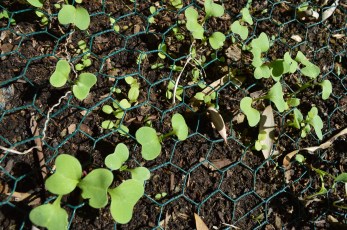
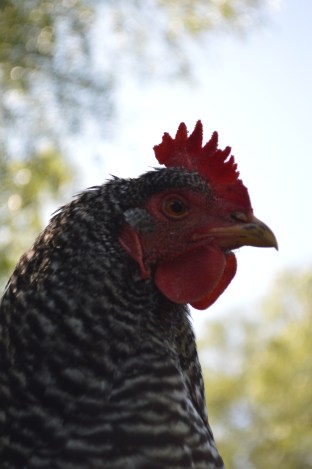
I also take full advantage of the rarely clear space in the garden, by sprinkling any aging seeds about. Seen above, some lettuce germinates with radish through a simple, put effective means of my chicken proofing the plot. (Sorry Betty) Betty is a spurred hen, a real sassy gal with a wonderful love of high kicking her way through the garden. She puts the “free” in free range.
I think this time of year is a great time to get mizuna, mustard, radish, collards and kales going. I love my greens, beans, pumpkins and such. So I plant heavily, and put them “up” in ferments, or use them for fresh eating. I also freeze my lima beans for making soups and chili.
Yesterday, as I plucked plump chayote from the vine, a gentle, female Jackson Chameleon caught my eye. She was a teenager, enjoying the afternoon mist and using the chayote vine as a bridge across the garden. It is a beautiful addition to my workday in the garden. I hope your garden is also filled with inspiration!
In the frantic days before I leave for California, I needed to put some serious order into the farm. I will be going to help harvest the Baker Creek pumpkin seed trails, and just a couple weeks later, I will be giving my speech at the National Heirloom Expo. The excitement is building, because one of my very own farm pumpkins is a part of the trials. I’ve worked hard so to stabilize the variety. I am hoping that when I get there, it will be shining in the sun, and offering resistance to the drought there. But for now, I need to focus on getting my own crop in order. Pumpkin growers frequently count the days when you need to hit your harvest right on schedule for October, and we in tropical and subtropical places need to look 120 days out, and sometimes more.
Hawaii’s high season also creeping closer, where the demand doubles. So, it is simply now or never. This year is a big soil building year, as well as planting all new pumpkin vines. It has been a long summer with quite unexpected weather patterns. We had Winter-like weather for weeks, including flooding, and now it is like Summer again. Adaptability is the name of the game.
The soil strategy is working. I have brought in several tons of hops, mixed them with wood chips from the farm, then piled them on top on salvaged cardboard. The trick is to turn the piles, carefully, letting them air out in all this heavy rain. For those of you just tuning in. In the farmlots, we got several days of flooding after 17 years of drought. Quite a change, but not entirely a surprise. Why? The drought/flood cycle goes together, like it or not. You cannot change the weather, but you can change your soil’s ability to adapt to changing weather. Adding soil structure through organic mulch materials, and valuable nutrients both help. This improvement to soil health also encourages the earthworm, and microbes…and on we go.
People are often overly concerned about how no-till looks, but really, it doesn’t matter how it looks, what matters is how is responds to the needs of your plants. We need to get over our thinking that everything needs to be in tidy rows, with nice big parched earthen walkways between. We are in a drought, and there is a lot more drought coming our way. By planting very close in super homemade soil, the healthy plants adapt and even help one another. I seed select only from varieties that are naturally resistant to powdery mildew (a huge problem in Hawaii) and then I can just let the vines sprawl, without worrying about close planted plants and powdery mildew. What people usually do not see, but you can in these images, is the under story of the mulch. Ever wonder why I have giant green squash leaves the size of platters? It is because I have created a natural fertilizer system on which they grow. When water hits a vine, it encourages it to re-root where the vine touches the soil, or in this case, where the vine touches the nutrient mulch. I can encourage growth by burying the vine, (like giant pumpkin growers do) and encouraging more roots to form and uptake more nutrients. This system is why I get so many tons out of a tiny parcel. A squash plant often produces 2-3 pumpkins, mine may produce 10 times that, because I feed and prune and feed some more. They are spoiled with love.
Here is a look at the mulch before the vines cover the lot. The system is as follows: cardboard, hops and wood chips mixed, some coral sand, coffee grounds, and fermented fish (buried in holes here and there.) Throughout the season, I will feed again with homemade fish emulsion, and top dress with more coffee grounds. Then too, I will add some EM-1 soil microbes fermented in grain to the field. Most of soil making is being done below those sprawling vines. Compost materials are the mulch. Soil is the solution.
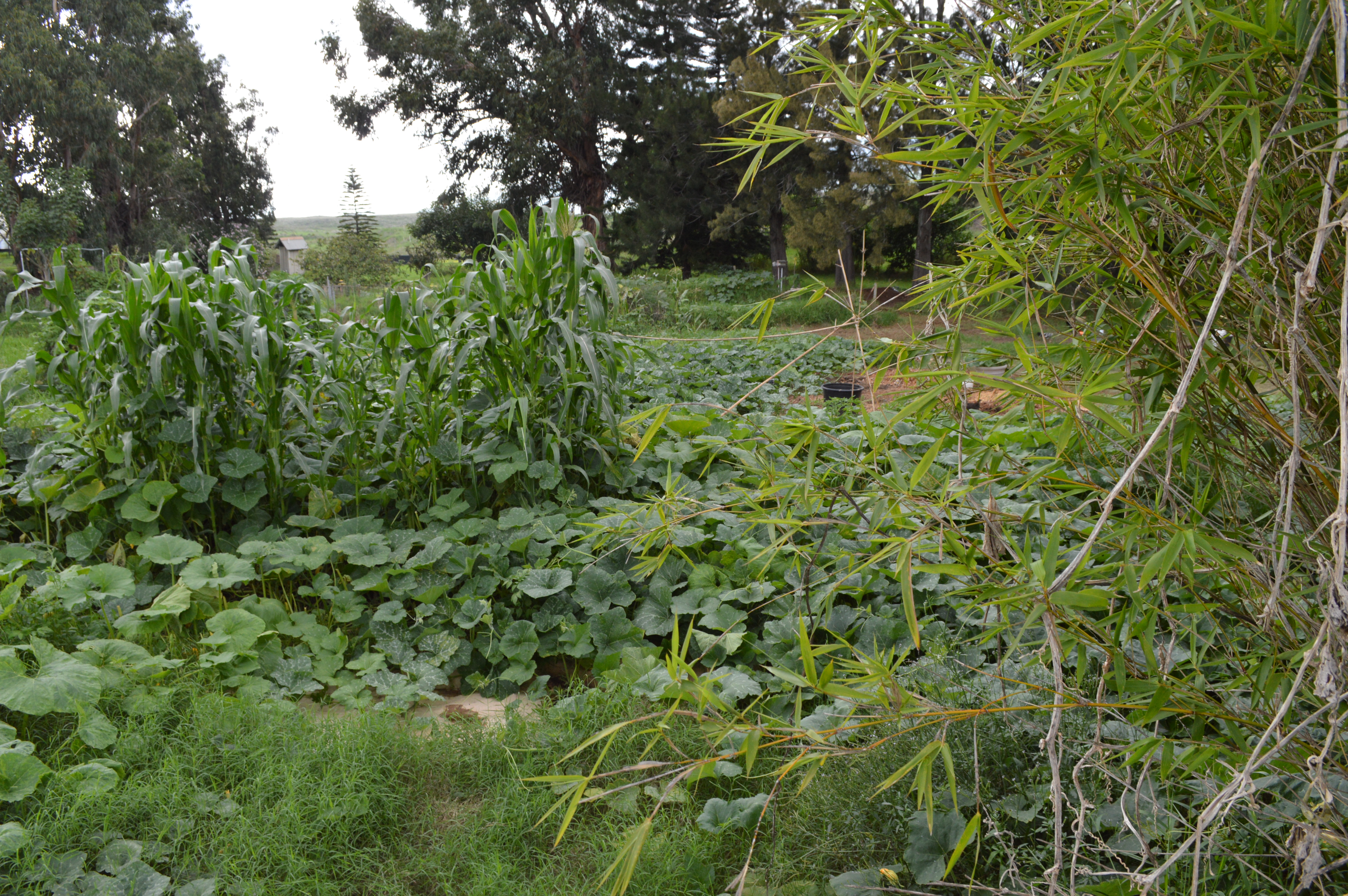
I plant close, I’ll admit it, too close. I am a chronic over planter, but I have my methods. One is making sure that, as one farmer summed, ” feed the heck out of your plants.” Yes, I do. Exactly. I set those plants up for success by giving them a lot of micro nutrients, worms lolling about, mulch to hold it all in, and you cannot forget my homemade fish emulsion. Like all good things, success comes from a layering method giving a strong base to grow just about anything. 
So it is mid July, it is now finally hot and sunny in upcountry Hawaii, and my May plantings are beginning to sprawl. What do I do? Prune the inner leaves and let the air circulate. Let the other plants like corn, tomatoes and flowers get to see the light, by removing the squash leaves that are very close to each other. A healthy squash plant will have “choke” (Hawaii slang for a lot) leaves. So cut off the ones dusted with mildew, give the bed a good soak with diluted fish emulsion, and let ’em sprawl. In the weeks ahead, they will smother the entire area where I shot this video.
Bear with the video, it is hot and mid day as I deliver this squinty, yell at the camera squash tip. But it is sent to you now, so that you can fully benefit from it. The extra fish emulsion will give it a boost of energy at week 6, a heavy vining time in the squash’s life cycle. So prune, put the leaves in hot compost so to rot it down. Don’t leave the leaves in the garden or you will encourage the powdery mildew. Bag the leaves in an old garbage bag, tie it shut, leave it in the sun to cook and kill the mildew before moving them to your compost.
I happen to breed varieties that are naturally resistant to Hawaii’s bouts of mildew, they are often unaffected, when a new trial plant is suffering in it’s first season. Only the strong plants survive my plant editing.
Powdery mildew is common here in Hawaii, even in dry up country. I mean very common. If a plant is getting a lot of natural nutrients, good air circulation, sun and water, don’t fret, maybe try a different species or variety of squash.
Only a small percentage of the squash varieties that I trial even like their VIP care. So many varieties simply don’t like growing here. Hawaii has a little bit of everything pests and disease, with the highly unpredictable growing conditions for plants, none of which is welcomed by many squash varieties. I tried to grow the super dependable Hubbard, and it didn’t like the farm conditions at all. Now that the soil is really soil instead of half rotted compost, it may like it. Sometimes it is the time of year that you plant, or even the day that you choose to plant on. If at first you do not succeed, try again. You will be a better farmer or gardener if you fall on your face a few times. Trust me. I do it all of the time.
One of the topics that I must address is the challenge beginning farmers face in having to experience “newness” all of the time. Beginning farming, establishing markets, and trialling seeds surround you with a lot of change, just like what we all face when starting down any new path. Add in that we also have to deal very directly with working in an unpredictable work environment. Ever changing weather, climate, markets, all make for a shifting situation, in addition to learning to farm in difficult times. Too much change can be stressful, and it will keep us from being our best. Facing the unknown on a regular basis does have some upsides, especially if you remind yourself that it is a part of learning. There are many issues in agriculture that can get me rattled, but on a day to day basis, I find myself trusting the process, and embracing the many aspects that come with trying to move forward as a new farmer. Each time we try new things, we challenge ourselves to step free and clear of safe zones. You are leading, and moving forward with every experiment, even if your idea fails commercially. Pushing yourself into new directions is uncomfortable at times, especially because the financial risks can be great. We all know that risk taking can be stressful, but let’s step back for a moment and allow us to look at things holistically.
Yesterday, I was fretting and thinking that I should be planting more squash for our Nov-Mar high season. Instead, I was pouring 200 gallons of spent hops from our local brewery into the farm’s soil. Let’s look at this for a moment. Instead of fretting, I tried to stop and realize that the great haul of free soil building materials is a real gift. It is a gift that will nurture my plants all season long. By stopping and taking those opportunities, I have found that the healthier plants grow faster, resist disease, and often surpass the growth of plants that were planted earlier, but didn’t get the additional care that soil amendments added to their life.
It is normal to fret when looking at agricultural Calendars. Time ticks on regardless. The irony is that my friends in short season areas often have faster growing plants and more abundant harvests than we do in long season, but up and down weather that higher elevation Hawaii has. In Hawaii, one of the toughest questions to answer is “when do I plant?” I was getting plants in the ground in March, and they are not any bigger than the squash vines in May. Why? We had a strange weather pattern. The faith in continuing on, and soil building instead of worrying about timing helped me greatly. I now have healthy seedlings that are soaking up the benefits of my soil building, even though they were planted later. Late and healthy are better than “on time” and sickly. Too many are tempted to throw up their hands when things swerve off schedule, or when drought, pests, or weather sidelines us. All I can advise is don’t let yourself get too rattled.
In just the couple years that I have been farming, I have learned to throw in some radish, or mustard seeds when the cool weather stays too long. Why? You will have a happy take away to soften the blow. Yes, your heat loving commercial crop may be late, but often there isn’t a single thing you can do about it. You are not going to change the weather, worrying isn’t going to help you, so you may as well have some food in your stomach. I do it all the time. It keeps my farming fresh, and my ability to adapt becomes a comfort for me. Yes, I get disappointed as chefs want me to produce more, but the vines are not having it. The plants can hit the pause button, and that is how it is. The pressures of producing 24/7/365 is an absurd standard that no farm can do. Soil needs to rest, plants need to rest, as do farmers. We are more likely to let the soil and the plants rest before we do. I once had a talk with a distributor who believed that some farms produce everyday of the year, what she didn’t realize is that the produce that is coming into Hawaii is pooled together at warehouses. It isn’t from one farm. Nature doesn’t work like that.
Adaptability is hard, it takes practice, and I don’t always do it well. Before I lash out at the cloudy cold weather, the drought, the this, the that, I try to see it as and opportunity to do something else that needs some attention. Sometimes the one that needs attention is me, as the farmer. A strange stormy sky drove me indoors for one hour last week. High winds interrupted my flow. I decided to put my feet up and read a couple of farming articles. It was rejuvinating and I felt like that break actually put me forward. The skies cleared, and my mind thought about the words I had just read. I completed all of the work that needed to be done, and that break gave me an idea or two of things that I could do at the farm. It also reminded me of our shared experience. Farming isn’t always appreciated, and often it is made fun of by people who may not even realize that their words cut through you. Not all of us are surrounded by an immediate support team, so make sure to read the stories of others that are doing things similar to you.
I pick up memoirs of farmers, chefs, travelers and foodies. They are a great source of inspiration because their road isn’t easy either. If it was, it wouldn’t make for a very good book. Farming memoirs are popping up here and there, and they can be great to keep nearby. I happen to love William Woys Weaver’s book of vegetable essays 100 Vegetables and Where They Came From
It is the kind of book that inspires in snippets perfect for a short break. William Woys Weaver can make anything interesting. He is a historian, chef, educator, gardener, and seemingly, a pretty dynamic individual as a whole. Remind yourself that your actions matter, and celebrate your role in our food system.
Sometimes an injury drives me out of the field and garage completely. It can happen to us all. When I get hurt, be it a knot in my back, or a sprained hand, I try to take it as an opportunity to expand my photography, writing, research, or my kitchen trials. The injury can lead to inspiration. Like other unexpected events, we can react in many ways. Injuries make me very aware of plan B, especially since I am a one person farm. Everything is on my shoulders. Being injured may sidetrack us from our immediate plans, but it has made me make changes that were very positive. One change that came from one too many slips and twists was as simple as changing my shoes. One of my customers observed that I carry about with 40-50 lbs in my arms at most times. She was right. That can be 1/3 to nearly 1/2 of my body weight. When I twist an ankle, or turn on a slippery floor, the additional weight is felt, and it can cause injury. Making a simple change to wearing better shoes, even sporting running shoes, made my delivery days more enjoyable. The wider base for your foot, the arch support, and lightness all made for a better, safer day. I calculated that in one day I lifted and moved 1850 lbs so to set up a photoshoot for the Hana Hou Magazine photographer that was visiting the farm. It was just a few bushels of pumpkins, but they were lifted and carried back and forth as props. It adds up. With the change to better shoes, I found that I was working longer hours, but I was less tired.
I don’t really want to get injured, nor do I desire windstorms, but I also know that when you choose to garden or farm, you put yourself in a very physical job immersed in unpredictable conditions. Complaining about the weather is a bonding experience for many of us, but let’s remind ourselves that we can use those unpredictable times to push us in a new direction, to reinvent, rest, or seek inspiration. Let a scorcher of a day lead you to an ice cream cone once in a while. Open a book and rest your back. Your productivity may actually increase. We may help to motivate a new generation of farmers if we treat ourselves with the same care and respect with which we treat out soil, our produce, and our communities. So let’s farm by example, and do our best to roll with it.
What if you thought that you couldn’t grow tomatoes or melons, or pumpkins, only to find out that you could have all along? A lot of Hawaii gardeners begin by thinking of mainland season, and mainland vegetables, Soon they watch their dreams fizzle as plant after plant fails. I read and respond to so many messages where all I can do is encourage experimentation, research, and expand your tastes. All kinds of plantings are possible, but sometimes, you have to be the one to figure out those possibilities. Now, so many of us have websites that can hopefully cut your research down by several seasons, if not years, But due to micro climates, what works for me may not work for you, or maybe it will. Often we must just try and see. Many just want answers, they just want seeds, while others are problem solvers and researchers.
Think it cannot be done? It can, trust me on that one. We are now mining history for seed solutions that have been solutions for many generations. They have just been pushed out of popularity due to commercial interests. It is not too late. The Internet connects growers and seed savers from around the globe.
 Possibilities are being rediscovered every season. So give it a try, and see if you can find your own solutions. Inspiration is contagious.

Squash are not known being team players in the garden, but are we giving them a fair chance? Squash will grow out and over everything in it’s path, but if you plant other vegetables at the base of your squash you solve many things at once, let me explain.
For example, the Three Sisters method was a smart interplanting solution invented by the Native Americans, including the Iroquois. Don’t believe me? Well, squash stars (well assists) in the beautiful flip side of the 2009 US Dollar coin. That is right, not only I say that squash can play fair in the garden, the evidence is minted.
Though I was not yet able to do a true, successful Three Sisters Native American planting technique, I’ve been able to keep true to the underlying truth that considered what plants need, and how those needs can be connected in a self caring system. I add in cherry tomatoes, or tomatillos, along with beans, corn, and squash. At times I add plantings of okra or sunflowers in lieu of corn. Tall stands of okra become an excellent resting spots for small birds that feed upon the pickle worm moths and other flying foes. They use the okra as a lookout spot before diving in for a bug. So for those of you who think that a squash farm is just squash, you are missing a lot of the fun, and a lot of the harvest. Not only does it create multiple crops from one watering and one application of fish emulsion, but it also is good for the soil.
Need more convincing? Please remember that squash vines will grow away from this central point, leaving the other plants to breathe. So give squash a chance in your small garden or farm. It will smother weeds, feed your family, and reduce water evaporation for those, like me, who grow in drought conditions. If the vines threatened to take over, prune them. It is that simple. There is little to lose, and much to gain.

People see me coming and going with lots and lots of cardboard. I get more than a few questions as to why. These videos should sort out my no-till methodology.




 Squash and Awe