Tag Archives: Hawaii

Proud to Represent Hawaii

Hawaii often gets left out of many agricultural events.  People often ask me why.  It is simple: fruit flies.  They have made our exporting of produce difficult for the last 100 years.  With that being said, they have also made it the most challenging place to grow many otherwise common vegetables.  Marketing has showcased pineapple and sugar, two plantation crops that are uneffected by these pests. But we are not so proud to note that every year, new agricultural pests erode what small food production we have in the Hawaiian islands. When asked why I didn’t bring squash to the expo, other growers just shake their heads.  Those who have been around a while usually say, “oh fruit fly? Lucky you are growing anything at all.”  They are right.

It is for that exact reason that I began researching, and later breeding squash for Hawaii, and other areas with tropical fruit flies, and the newer introduction, Pickle Worm.  When California gets an invasion of fruit flies, they sound the alarms.  When Hawaii gets a new pest, it barely makes the news.  Another one, is not what any of us need.  But they continue to come in every year.  That is one of the many downsides of importing over 90% of your food.  It leaves the door open for pests from around the world to enter the islands.  Don’t believe me, try talking to someone from Australia.  We have many of the same issues.  I had more than one person ask for my squash at the National Heirloom Expo last year, I had to direct them to the images on my booth,  often the response was, “couldn’t you smuggle one in?”  I know they meant well, wanting me to represent my breeding and farming efforts with the real thing, but the very last thing I want to do is destroy California agriculture so that I can have something to show.  I explained the magnitude of what one selfish act could do.

But after having so many inquiries, I just thought my way through the situation.  Though I could not bring squash into California, or anywhere else in the US, I could get seed through. I wanted to collect more research data, as I entered year 4 of my farm’s independent research for squash in Hawaii.  It was brought to my attention, that maybe I should include it in the Baker Creek squash trials.  I will be telling that story at a later time, but for now, I just wanted to share the very good news that the Hawaiian Black Kabocha not only survived, but it produced in a very different environment, and surrounded by all new pests, and squash virus.  Why does this matter?  It matters in many more reasons other than having a squash in the line up at the expo.  It is another potential solution for islands and areas suffering from both fruit fly and drought.  It can be a solution for the food production efforts of other places.  The labors of one can help many.  After the expo I received an angered email that noted how self-centered my actions were.  Now, it was time for me to shake my head, knowing in my heart, he couldn’t be further from the truth. So Hawaii, this was for you.  Mahalo nui loa for the dozens of top ranked chefs who taught me the nuances of flavor, so that I could be a better informed squash breeder.  Because it is simple, if I am going to be breeding for pest resistance, I may as well breed for excellence in flavor and texture as well.  Hit that ball out of the park for all of us.

So here she is sitting pretty in the line up.  Only a Hawaii grower knows how much that means to get her there.

DSC_0691

Farm Clean up: the no-till way

In the frantic days before I leave for California, I needed to put some serious order into the farm. I will be going to help harvest the Baker Creek pumpkin seed trails,  and just a couple weeks later, I will be giving my speech at the National Heirloom Expo.  The excitement is building, because one of my very own farm pumpkins is a part of the trials.  I’ve worked hard so to stabilize the variety.  I am hoping that when I get there, it will be shining in the sun, and offering resistance to the drought there.  But for now, I need to focus on getting my own crop in order.  Pumpkin growers frequently count the days when you need to hit your harvest right on schedule for October, and we in tropical and subtropical places need to look 120 days out, and sometimes more.

Hawaii’s high season also creeping closer, where the demand doubles. So,  it is simply now or never.  This year is a big soil building year, as well as planting all new pumpkin vines.  It has been a long summer with quite unexpected weather patterns.  We had Winter-like weather for weeks, including flooding, and now it is like Summer again.  Adaptability is the name of the game.

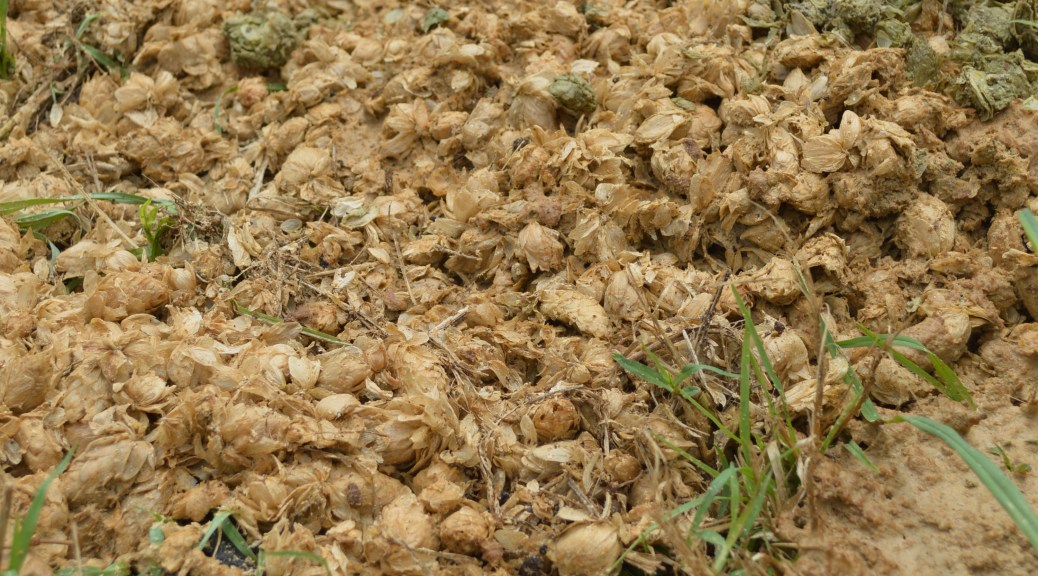
The soil strategy is working.  I have brought in several tons of hops, mixed them with wood chips from the farm, then piled them on top on salvaged cardboard.  The trick is to turn the piles, carefully, letting them air out in all this heavy rain.  For those of you just tuning in.  In the farmlots, we got several days of flooding after 17 years of drought.  Quite a change, but not entirely a surprise.  Why?  The drought/flood cycle goes together, like it or not.  You cannot change the weather, but you can change your soil’s ability to adapt to changing weather.  Adding soil structure through organic mulch materials, and valuable nutrients both help.  This improvement to soil health also encourages the earthworm, and microbes…and on we go.

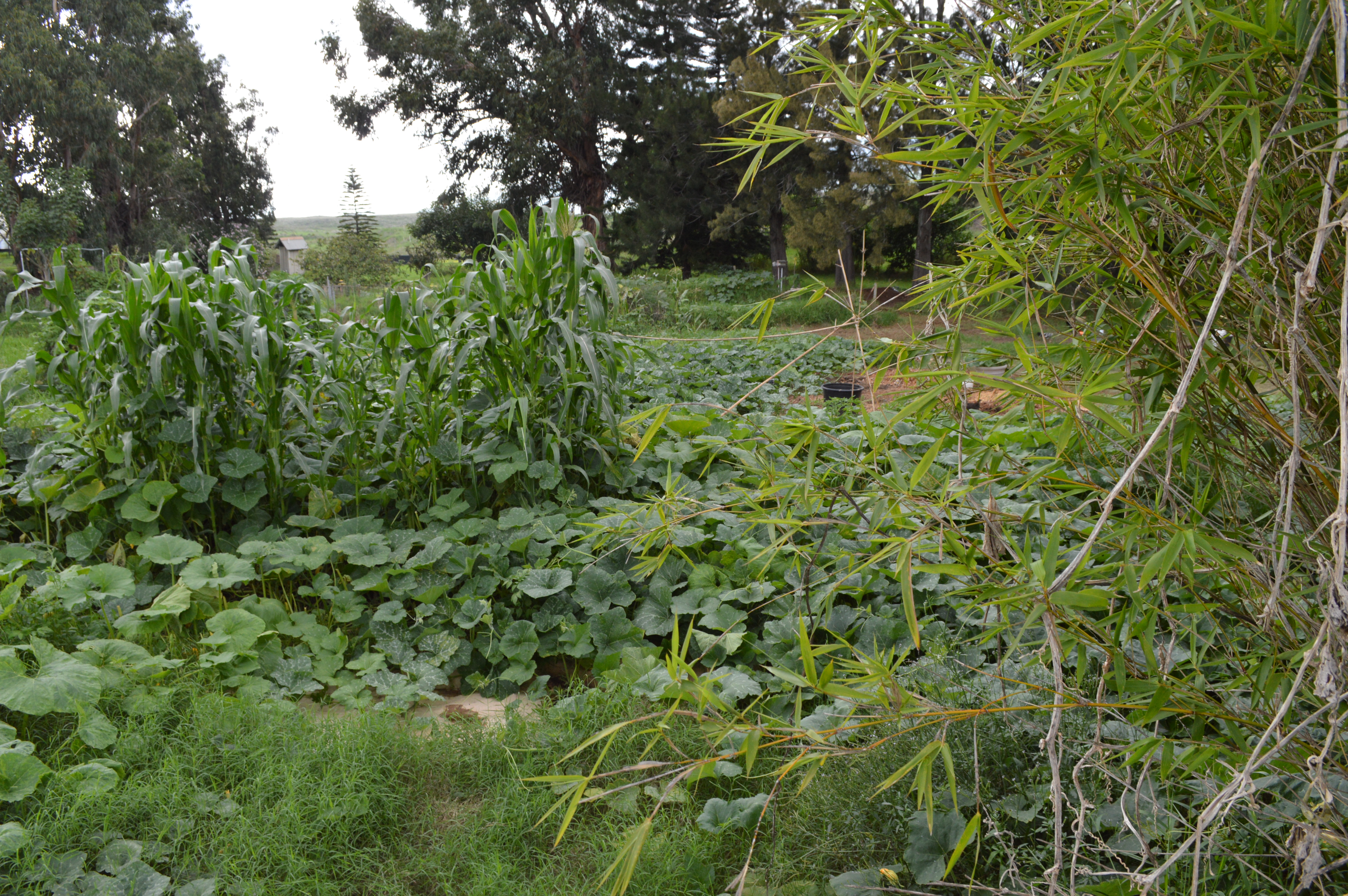
People are often overly concerned about how no-till looks, but really, it doesn’t matter how it looks, what matters is how is responds to the needs of your plants.  We need to get over our thinking that everything needs to be in tidy rows, with nice big parched earthen walkways between.  We are in a drought, and there is a lot more drought coming our way.  By planting very close in super homemade soil, the healthy plants adapt and even help one another.  I seed select only from varieties that are naturally resistant to powdery mildew (a huge problem in Hawaii) and then I can just let the vines sprawl, without worrying about close planted plants and powdery mildew.  What people usually do not see, but you can in these images, is the under story of the mulch.  Ever wonder why I have giant green squash leaves the size of platters?  It is because I have created a natural fertilizer system on which they grow.  When water hits a vine, it encourages it to re-root where the vine touches the soil, or in this case, where the vine touches the nutrient mulch.  I can encourage growth by burying the vine, (like giant pumpkin growers do) and encouraging more roots to form and uptake more nutrients.  This system is why I get so many tons out of a tiny parcel.  A squash plant often produces 2-3 pumpkins, mine may produce 10 times that, because I feed and prune and feed some more.  They are spoiled with love.

Here is a look at the mulch before the vines cover the lot.  The system is as follows:  cardboard, hops and wood chips mixed, some coral sand, coffee grounds, and fermented fish (buried in holes here and there.) Throughout the season, I will feed again with homemade fish emulsion, and top dress with more coffee grounds.  Then too, I will add some EM-1 soil microbes fermented in grain to the field.  Most of soil making is being done below those sprawling vines.  Compost materials are the mulch.  Soil is the solution.

the farm in year 3

The Lima Bean Squash Taco with Homemade Kraut

I decided to cook up some of my heirloom Christmas lima beans and make a casserole.  With a lot of work to do in preparation for the National Heirloom Expo, I need my energy.  I had the food processor out with the shred blade on, as I was already making my pipinola (chayote) kraut.  I was also sitting on several pounds of zucchini from a farm trade that I made with our local CSA.  I decided to just keep shredding and make a taco seasoned dish that I could use throughout the week. Here is what I did:  I had cooked the Christmas lima beans on low overnight in the crockpot with water enough to cover, and 1/2 of a Sweet Onion. I was already planning on using the beans, so I thought that all I needed was some more vegetables.I shredded one half of a large Hawaiian Sweet Onion, One large Zucchini, one pipinola(chayote squash) 2 orange habanero peppers, and 5 pickled hot peppers.  I then poured the shredded veg into a bowl, and pulsed 2-3 cups of the now room temperature cooked lima beans.  I added them to the bowl, and added two packages of taco seasoning, a sprinkle of sea salt, and a cup of breadcrumbs.  I mixed it all together and pressed it into a 9×9 square pan, baking it at 350 degrees for an hour.

I’ve been making homemade kraut for several weeks now, as a means of capturing the harvests that come and go at both the farm and garden. The salty zing of the sea salt brine is welcomed after a hot day in the field.  I thought, why not?  Add it to the taco.  I am happy to learn that this one taco casserole makes two completely different dining experiences.  Fresh out of the oven, it is warm and comforting, with melted cheese and steamed rice for an evening meal, but the next day, it is bright and light as a chilled lunchtime taco with the ice cold kraut.

Since I am doing a lot of physical labor, I need a lot of food energy to get me through the day, so this homegrown, healthy taco had enough staying power to keep me going. Granted, my farmer portion was probably a bit larger than many would make.  Overall, it was a simple feast made out of farm and garden goods.  I will certainly make it again soon.

Try experimenting, I am sure carrots or pumpkin would be equally nice additions to the taco.  Just think in terms of a meat loaf minus the meat.  You can add two beaten eggs to the mix as well, or add chopped boiled eggs if you are a hungry one like me. As for the kraut, I have made a wide variety of them in my initial experimentation.  It is all based around what is in arms reach. I have a few chili peppers producing now, and I always keep fennel fronds near.  Though I am not a seaweed (limu) collector, I support those few that do here in Hawaii.  I have been using seaweed as the majority of the salt in the recipe, topping off jars with just a bit more salt for fermentation.  If you haven’t read it, you may enjoy my earlier post on my summer fermentation trials with pipinola (chayote)

DSC_0753

Aloha from Squash and Awe

Planting Chili Peppers in Containers

It is an interesting year for chilis in Upcounty Hawaii.  Cold, wet, Winter weather has changed their schedule.  This is normally time for their big growth time, but this year the season is different.  Am I ok with it?  Sort of.  This is why I plant so many heirloom varieties.   Some are loving this weather, while others are waiting for their time.  I learned many things this year.  The importance of pruning, and timing the pruning to the plant’s growth cycle.  I also learned how to grow chilis from cuttings.  Though only one lone Thai Dragon Pepper was a successful grow out from a cutting, it is a lovely plant, and I learned that the method does work, and that I should try it throughout the year to find ideal times.

I also did two rounds of grow outs from seed despite my Spring travels.  I have two new success with orange Habanero, and Purple Cayenne.  Then back to making sure to care for the varieties that have already shown potential. Like Black Hungarian, and Aji Limon (Lemon Drop.)  Two peppers from two different parts of the globe, but both like the highly variable conditions at the farm.

I love to plant and transplant when it rains.  Though it is bright and sunny in the video, the skies opened and closed several times in the past few days as yet another tropical storm spins by.  I decided to start an absurd number of chilis this summer, knowing that it was now or never.  Germination becomes more difficult in the months ahead.  Many chilis go semi-dormant in Winter, unless we have a warm Winter.  I get them going when we still have longish days, then we will see what the fall brings.  It may get hot in Aug and September, which would set them up with strong growth.  Or we may be having our Winter now.  We never had Winter rain this year…so in many ways this is our Winter.

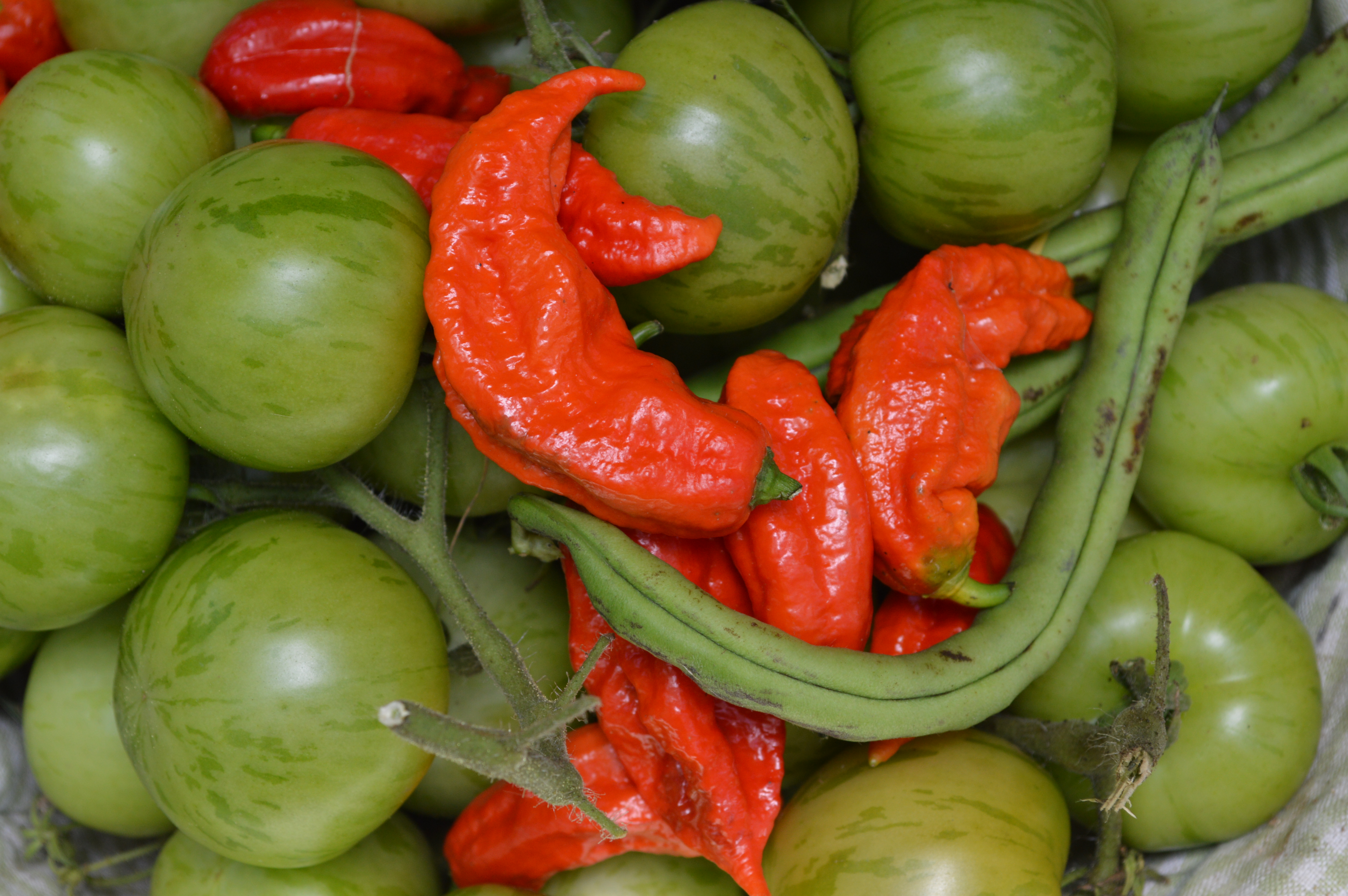
What I am learning, is that I may love chilis as much as I love squash.  They too vary in heat, texture, and flavor.  They also have lovely foliage, and flowers.  They also are more tolerant than I would have ever guessed.  They let the squash smother them, then appear alive and well from under the vines.  I have some plants that are 2.5 years old now.  They love my homemade fish fertilizer, and the Ghosts seems to like more water than I would have ever guessed.  I harvested about 15 Ghosts off one yearling plant that is set right out with the squash.  I have it in a container tub, and let it get some of the spray in route to the squash.  It is a great way to have them be accessible, while also lifting them up above the squash leaf shade so they have optimal sun.  Not to mention, it is easy to collect them so to cook with them, and one watering will water the whole lot.  Containers can dry out quickly, so this is ideal.  The peppers are healthy, happy, and thriving.

Ghosts warn you of heat with color and a strong scent

So here is a video to give some beginning farmers and gardeners an idea of how to make your own soil mix for your container garden.  I recommend that everyone grab up large pots and tubs when they seem them being discarded.  They come in handy, and it allows you to have a garden on your lanai, doorstep, or in my case, containers mix right in with other plants on the farm.

I choose to transplant my chili peppers when they get a couple pairs of leaves.  That gives them a more substantial root system, and they are less likely to wilt and die after transplanting.  I get several plants going in each big container, if they all take, I can always transplant some of them, giving the others more space.  I often add a squash vine to the mix ( I know I know) or a basil plant, so to get a variety going.  These containers will be put on a wire mesh table top where nutrients, and water will drizzle onto the squash vines.  I give them fish emulsion monthly. It works wonders.  The two year old plants have over 100 blooms this year…even in partial shade, and unusual weather.

I began fermenting this past week, and I am excited about the flavor of the orange Habanero in one of the squash ferments.  More on that later…I am just throwing that out so to encourage you all to grow more than you think you will use.  Many people struggle with growing a variety of peppers, so they may be likely to trade for some of your chili bounty.

Fermenting My Way Through Summer: Pipinola/Chayote

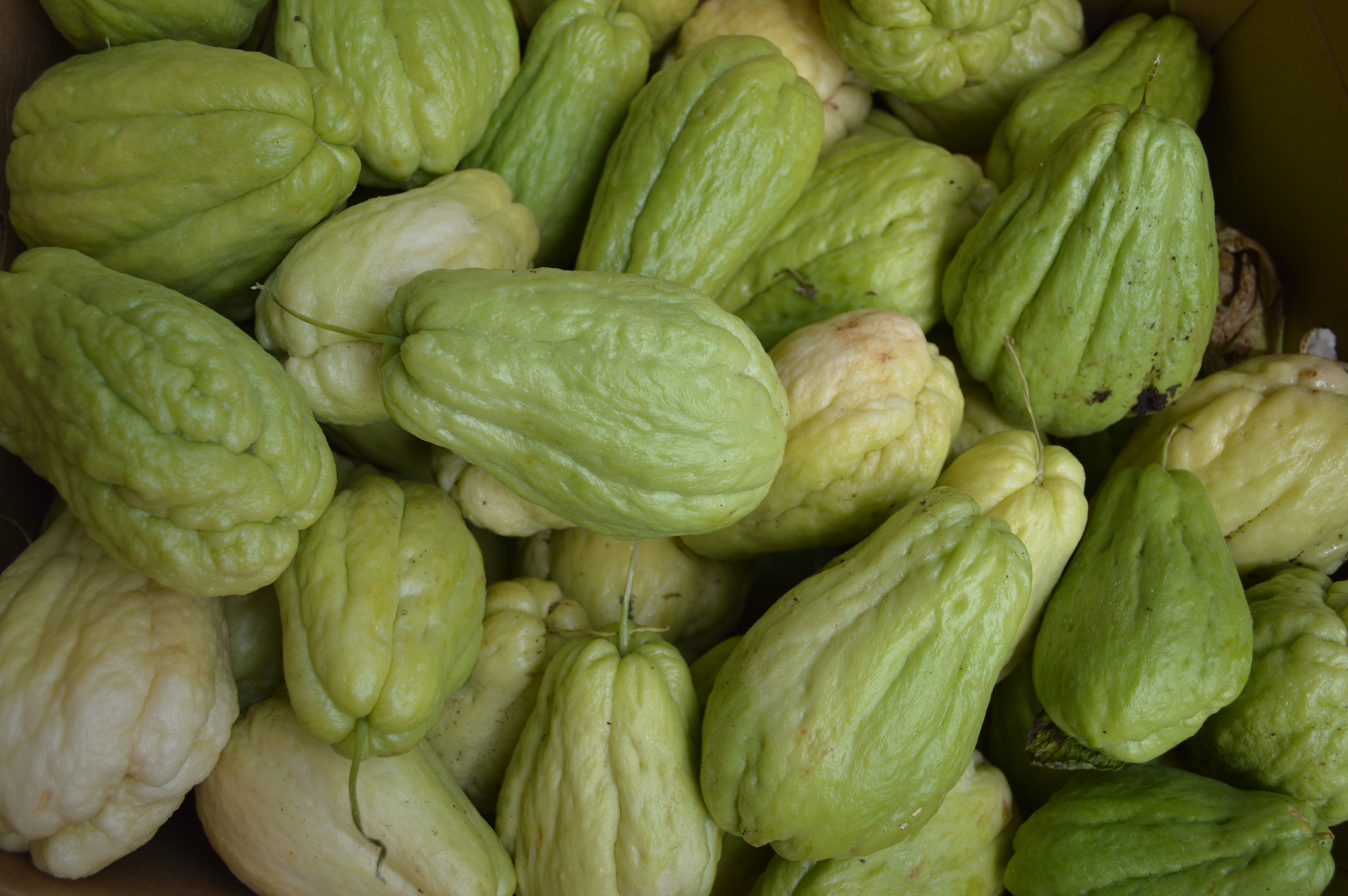
For those growing in Hawaii, we know Pipinola, also known as Chayote, but we may not know what to do with it.  This squash relative is a big climber, which can be a blessing, or not so much, depending on where it is growing.  Edible from the chestnut like seed, to the fruit, leaves, and even the tasty stem tips too.  Like all squash, every single bit of it is useful, and edible. Even the pig adores them, as she crunches them like apples.  They do not have a great deal of nutrients, nor do they have a lot of flavor, which brought me to ask, “what do I do with a bushel of them?”  When conditions are right, they will produce a lot at once.My method is to harvest, and follow by pruning the vines heavily twice a year.  The green material is perfect for adding to your compost, the lush vines help to conserve garden moisture, and they make for a very useful pig food/bedding making for what I call Hannah’s edible bed. The vines will soon produce more than you know what to do with, or at least that is how it was, but now this changes everything.

DSC_0745

As I was sorting through vine and pipinola fruit, separating the split sprouting fruits out so to replant, or fed to the pig. The small medium and even larger ones seemed to have untapped potential. An idea popped into my head:  could this be fermented? I kicked off the rubber boots and looked it up online.  In the Americas, expats often use them for kraut.  There were several references to how they are available in Mexico, Central, and South America, by the bag or bushel.  Elisa Fusi charmed my idea with this wonderful blog post about her organic farming and cooking while visiting Panama.  More and more recipes turned up as I sat by the computer.  I was growing excited, and needed to begin.  I keep couple cases of jars on hand at all times, because, you just never know when a storm is going to hit and you need to put up a bushel of something.

The recipes varied primarily in the way they let the fermentation take place.  Some used jars with lids, some used crocks, one used a bowl covered in plastic wrap.  I decided to use the jars, since my counter space is limited, and having them ferment in the jars seemed one step closer to being completed.

Each recipe called for a slightly different amount of salt as well.  So here is how I did it:

Washed down counter, cutting board, and selected a knife.

Pulled a box of kosher salt and a large glass bowl out of the cabinet.

Washed jars, and set them aside with new lids

DSC_0747

I pulled out the ol’ trusty thrift store Cuisinart, and selected the shred blade, feed tube pusher, and the tool that slides into the shred blade and fits it to the machine. I made a nice work area with several clean dish towels up and out of the way.

I washed and sorted the pipinola/chayote, then quartered or halved them to fit in the food processor feed tube.  I left them clean and in two colanders so to keep them close at hand.  There is no need to dry them.

Next, I rifled through the spice drawer looking for underutilized, but fresh spices.  Several recipes called for caraway seed, which I use in my Irish Beer Bread.  I am sitting on a goldmine of fennel seed and lemon grass too. I pulled some garlic too.

Then I started shredding until I filled the whole container.  Then emptied it into the glass bowl.  I added about 4 teaspoons of salt, to over a quart of shredded squash, a dash of caraway seed, and minced two garlic cloves.  I massaged it all together for about 5 minutes.  In that time, the pipinola begins to foam and release liquid.  I then loaded the soon to be kraut into jars, leaving an inch of room at the top, and pressing the mixture down firmly.  Liquid should cover the kraut.  The lid is screwed on, and they were placed one after the next onto a shelf out of the sun.

I could have walked away at that point, but instead, I kept going.  I had just bought fresh seaweed, and the orange Habanero were producing, and I cannot make anything without pumpkin, I was skidding into a creative buzz.  So I kept going, and trying all kinds of made up combinations.  I treated each in the same manner, of packing the solids down, and having enough brine to cover them.  I backed off on the salt when adding salt-laden seaweed, I pumped up the garlic and chilis to make a sort of “Squash-chi” kraut kimchi combo.

Each day has begun with my taking five minutes to open them all, release any air pressure that built up, and then smoosh down the solid material so to keep it pressed together, and below the brine line.  We are now at day 4, and I have already eaten a pint through my daily sampling, so do make plenty.  I have just gifted jar today, and I am sure there will be some requests for trades.

I made a trade today, exchanging my pumpkin for zucchini, I thought that that may be nice to use as well.  I picked up some Hawaii grown Sweet onions too.  So the day is filled with promise for fermentation, since I still have most of the bushel of Chayote still to go.  Overall, it was easy, fun, and I felt like it made a great product out of a rather extraordinary harvest.

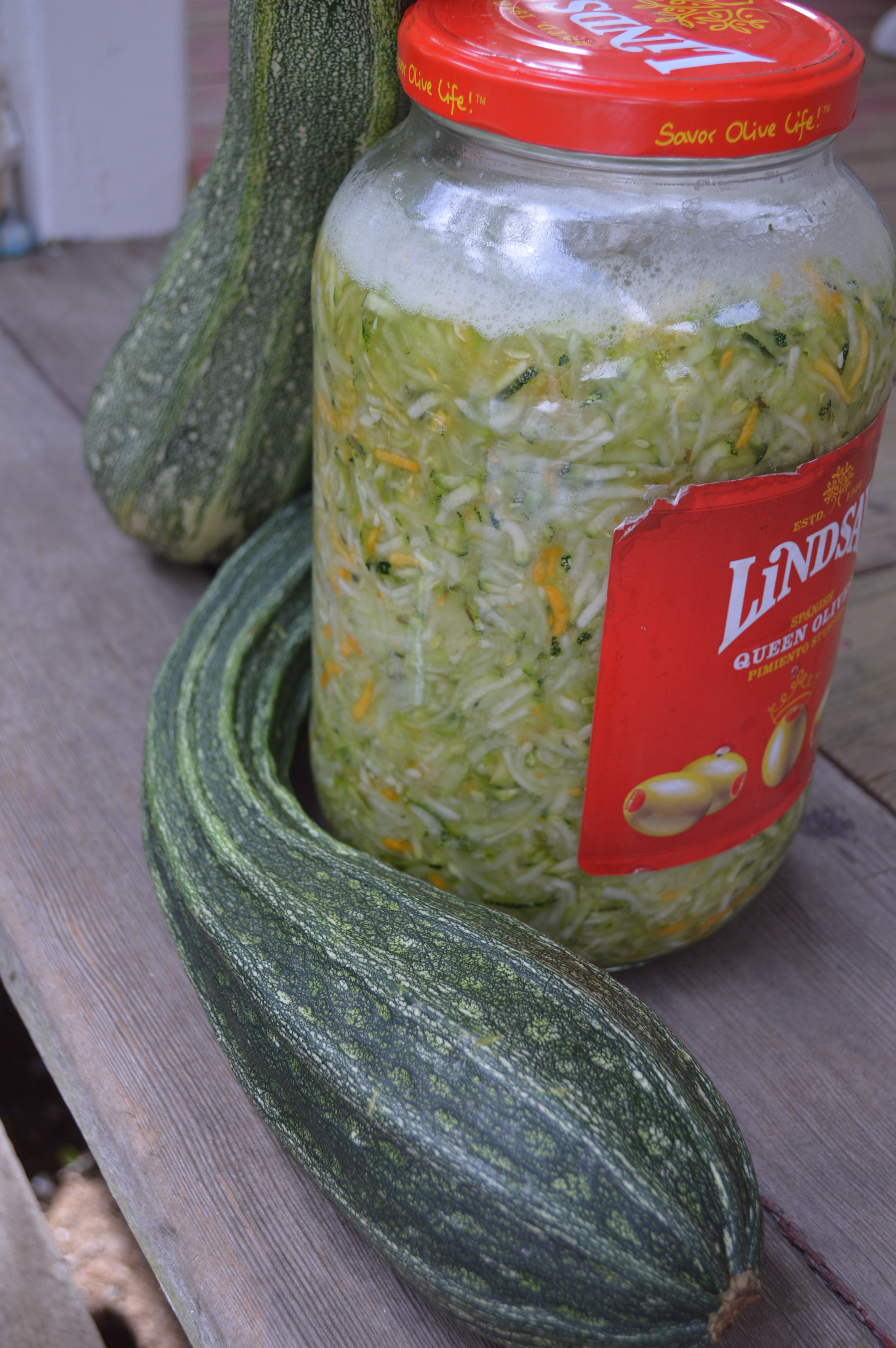
Three Squashkraut
A gallon jar from a restaurant makes the job easy. A trade with another farmer makes my range more interesting. This is 3 squash kraut with sweet onion.

These will all be refrigerated in the next week.  They will then keep in the fridge for months.

Population Density and the Farm

People dream of farming on Hawaii Island, aka the Big Island, and they are inspired by all of the potential that it holds.  So these agriculturally minded people create interesting CSAs, they make farms, and aspire to be a farmer’s market vendor.  What most of us fail to consider is the weight of a low population density and how it will affect business.  Without growing the demand for such goods, we will soon be in trouble.  Why? A lot of space between populations means long delivery distances.  With only a few restaurants that buy local produce, that  means that you must have all of them on your team. As in 100%. And that is tough to do unless you are the only farmer around.  That sounds funny, but I have met people in other parts of the country who have a lot of customers because they deliver a great product, but equally important, they have a captive audience and no competition from other farmers or imported goods.  That is an amazing scenario, but not likely here in Hawaii. And we all know that we are not getting much income off our markups in the first place.  We have to produce the product too. I am not discussing “hobby farms” here, I mean to address the issue of farmers that have to survive off their farming.  A friend of mine just couldn’t relate.  I only half-jokingly noted that it is like a realtor having to build the house, go door to door trying to sell it, then get only a few dollars over cost, or even not cover the costs, then immediately do it all over again.  Like I said, it is only half-joking. Maybe that isn’t a perfect example, but farmers are in a really different situation than most people can relate to.

Though in the past three years, I have only stuck one toe into the pools of complexity that surround agriculture in Hawaii. I was more than a little discouraged to find out that almost no farmer that I know is making a living off farming.  They are considered part-timers because their spouse hold a ft job in an office, a non-profit, or a hotel. It is survival.  Right now, grant monies are being directed to new farmers, and as these programs churn out students of all ages and abilities, in our nation’s most expensive place to live, it is hard to tell these inspired new farmers that on top of all else, they need to enter into the difficult task of building new markets as well.

So let’s get back to population density.  On my May trip to Oahu, I saw a familiar face at a unfamiliar farmer’s market. There was the banner of one of my neighborhood farms.  Why on earth were they selling leafy produce on Oahu, several island away from their farm?  It wasn’t just them, there was another Hawaii island farmer there as well, he noted that, “We just don’t have the business that we need to survive.” So they fly to Oahu every Saturday?  Looks like it.  Another well-respected local farmer ships about 90% of his produce to Maui.  Same idea.  Maui has a population density that we do not, and they also have a much better chance of someone caring that their produce is sustainably produced. It is at best, daunting to consider those logistics for farm survival.  Air travel to another island is not cheap in Hawaii, nor is shipping food.  Leafy greens are light, but they require refrigeration.

So what are my suggestions?  One is that I think we need to make a more intensive effort of gardening on Hawaii Island.  Switch gears back to the backyard.  We have yards on the big island, and with some training in soil building and gardening, it is quite possible to grow quite a bit of your own food.  Another idea is to build the movement. One long time Hawaii island resident noted that the desire for local, sustainable food never really took off, in fact it may have been better in the 70’s.   My research indicates that they are right, in the 70’s over 80% of the island’s food was from Hawaii, much of it from this island.  So are we backsliding?  Maybe.  The increase in our island’s importation of foods combined with a locally grown following that isn’t increasing at the same rate.  It feels like it is growing, but from what I hear, local is on many peoples lips, but not on a large number of Hawaii island plates.  I know a lot of circles who buy a large percentage of local produce, but I also know the Costco set who proudly announce that they bought produce from Europe that morning.

Pruning Squash Leaves for Plant Health

I plant close, I’ll admit it, too close.  I am a chronic over planter, but I have my methods.  One is making sure that, as one farmer summed,  ” feed the heck out of your plants.” Yes, I do.  Exactly.  I set those plants up for success by giving them a lot of micro nutrients, worms lolling about, mulch to hold it all in, and you cannot forget my homemade fish emulsion.  Like all good things, success comes from a layering method giving a strong base to grow just about anything.  DSC_0409

So it is mid July, it is now finally hot and sunny in upcountry Hawaii, and my May plantings are beginning to sprawl.  What do I do?  Prune the inner leaves and let the air circulate.  Let the other plants like corn, tomatoes and flowers get to see the light, by removing the squash leaves that are very close to each other.  A healthy squash plant will have “choke” (Hawaii slang for a lot) leaves.  So cut off the ones dusted with mildew, give the bed a good soak with diluted fish emulsion, and let ’em sprawl.  In the weeks ahead, they will smother the entire area where I shot this video.

Bear with the video, it is hot and mid day as I deliver this squinty, yell at the camera squash tip.  But it is sent to you now, so that you can fully benefit from it.  The extra fish emulsion will give it a boost of energy at week 6, a heavy vining time in the squash’s life cycle.  So prune, put the leaves in hot compost so to rot it down.  Don’t leave the leaves in the garden or you will encourage the powdery mildew.  Bag the leaves in an old garbage bag, tie it shut, leave it in the sun to cook and kill the mildew before moving them to your compost.

I happen to breed varieties that are naturally resistant to Hawaii’s bouts of mildew, they are often unaffected, when a new trial plant is suffering in it’s first season.  Only the strong plants survive my plant editing.

Powdery mildew is common here in Hawaii, even in dry up country.  I mean very common.  If a plant is getting a lot of natural nutrients, good air circulation, sun and water, don’t fret, maybe try a different species or variety of squash.

Only a small percentage of the squash varieties that I trial even like their VIP care.  So many varieties simply don’t like growing here.  Hawaii has a little bit of everything pests and disease, with the highly unpredictable growing conditions for plants, none of which is welcomed by many squash varieties.  I tried to grow the super dependable Hubbard, and it didn’t like the farm conditions at all.  Now that the soil is really soil instead of half rotted compost, it may like it.  Sometimes it is the time of year that you plant, or even the day that you choose to plant on.  If at first you do not succeed, try again.  You will be a better farmer or gardener if you fall on your face a few times.  Trust me. I do it all of the time.

For the Love of Hops

The Beer Garden is the nickname of my small farm parcel.  On April 1, 2013 (April Fools Day) I began to soil build.  When you know that you are growing a hungry crop, you know that you need to build your nutrients in as part of the plan.  So from day 1, spent hops from the award winning Big Island Brewhaus were used to amend the soil.  I am doing no-till, so the hops are dug into the growing piles.  Much like a 1/4 acre compost heap, it takes some attention and care to see that the soil stays healthy and that your microbes and worms can thrive.  People laugh when I say that it is a huge effort to “turn” a 1/4 acre.  Remember that each time I turn the farm, my zero-waste principles are at play.  Sure, it is easier to rip up plastic ground cloth, roll it into a ball, and drop it into our landfills, then they over till, and spray. That is one strategy, where you may save time there, but in the big picture, you are not saving anything. I do the opposite of that.  Each foot will either have a plant growing there, or will be used as a re-rooting place where vines will be buried under the homemade soil and get another hit of nutrients.

Yes, the other method can be done in a day, but your soil is on borrowed time, while mine is surging forward.  My labor of hauling and lifting create a nice, rich soil that holds water.  In a drought…that is worth gold.  So think before we discard.  Make connections with these local businesses who would like to help their farmers.  Yes “their” farmers.  Farmers belong to the community in the best possible way.

Here is a video where I explain a bit more about amending with fermented fish and brewery waste

I always do the warning about hops and dogs…they are poisonous to dogs, so watch your pet.  Many dogs have zero interest, but be cautious.

The image says it all.  The additions have changed the soil dramatically.
The image says it all. The additions have changed the soil dramatically.

So think about how you can make super soil.  This farm is small, but my soil is mighty.  Be a steward, and you will be rewarded with a bountiful harvest, reduced pests, and you will be a hero to the kindergartners…and who doesn’t want that?

Try (New Things)

What if you thought that you couldn’t grow tomatoes or melons, or pumpkins, only to find out that you could have all along? A lot of Hawaii gardeners begin by thinking of mainland season, and mainland vegetables, Soon they watch their dreams fizzle as plant after plant fails. I read and respond to so many messages where all I can do is encourage experimentation, research, and expand your tastes. All kinds of plantings are possible, but sometimes, you have to be the one to figure out those possibilities. Now, so many of us have websites that can hopefully cut your research down by several seasons, if not years,  But due to micro climates, what works for me may not work for you, or maybe it will.   Often we must just try and see.  Many just want answers, they just want seeds, while others are problem solvers and researchers.

DSC_0964

Think it cannot be done? It can, trust me on that one.  We are now mining history for seed solutions that have been solutions for many generations. They have just been pushed out of popularity due to commercial interests. It is not too late.  The Internet connects growers and seed savers from around the globe.

hidden Marina Di Chioggia Possibilities are being rediscovered every season. So give it a try, and see if you can find your own solutions.  Inspiration is contagious.

DSC_0404

Interplanting With Squash

Squash are not known being team players in the garden, but are we giving them a fair chance?  Squash will grow out and over everything in it’s path, but if you plant other vegetables at the base of your squash you solve many things at once, let me explain.

For example, the Three Sisters method was a smart interplanting solution invented by the Native Americans, including the Iroquois.  Don’t believe me? Well, squash stars (well assists) in the beautiful flip side of the 2009 US Dollar coin.  That is right, not only I say that squash can play fair in the garden, the evidence is minted.

Though I was not yet able to do a true, successful Three Sisters Native American planting technique, I’ve been able to keep true to the underlying truth that considered what plants need, and how those needs can be connected in a self caring system.  I add in cherry tomatoes, or tomatillos, along with beans, corn, and squash.  At times I add plantings of okra or sunflowers in lieu of corn.  Tall stands of okra become an excellent resting spots for small birds that feed upon the pickle worm moths and other flying foes.  They use the okra as a lookout spot before diving in for a bug. So for those of you who think that a squash farm is just squash, you are missing a lot of the fun, and a lot of the harvest.  Not only does it create multiple crops from one watering and one application of fish emulsion, but it also is good for the soil.

Need more convincing?  Please remember that squash vines will grow away from this central point, leaving the other plants to breathe. So give squash a chance in your small garden or farm.  It will smother weeds, feed your family, and reduce water evaporation for those, like me, who grow in drought conditions. If the vines threatened to take over, prune them.  It is that simple. There is little to lose, and much to gain.

Glass Gem popcorn, Tigerella tomatos, Hawaiian Black Kabocha, Jimmy T's Okra, Rattlesnake pole bean...in harmony
Glass Gem popcorn, Tigerella tomatos, Hawaiian Black Kabocha, Jimmy T’s Okra, Rattlesnake pole bean…in harmony